

TECHNOLOGY FOCUS: Data-Driven Flour Mills
According to industry data, modern milling technologies can increase flour extraction rates from wheat while reducing energy consumption by 25-30%.

Data-Driven Flour Mills: Redefining Efficiency and Competitive Performance.
Not long ago, the performance of a flour mill depended largely on mechanical reliability and the experience of its head miller.
Adjustments to roll gaps, feed rates and tempering moisture were guided by skill, observation and laboratory results that often arrived hours later. Today, that operating model is steadily giving way to something more interconnected.
The flour milling industry is entering a phase where performance is no longer defined solely by mechanical precision.
Instead, it is increasingly determined by how effectively mills capture, interpret and act upon operational data.
Globally, millers are investing in digital integration not as a luxury but as a structural requirement to maintain extraction rates, reduce energy intensity, and meet tighter food safety regulations.
According to Future Market Insights, the commercial grain mill market is projected to reach USD 2919.0 million by 2035, driven by increasing demand for flour production, feed processing, and specialty grain products that require precise particle size control and contamination-free processing environments.
The ability of flour mills to support bulk processing with efficiency and cost effectiveness has further reinforced their adoption.
According to industry data, modern milling technologies can increase flour extraction rates from wheat while reducing energy consumption by 25-30%.
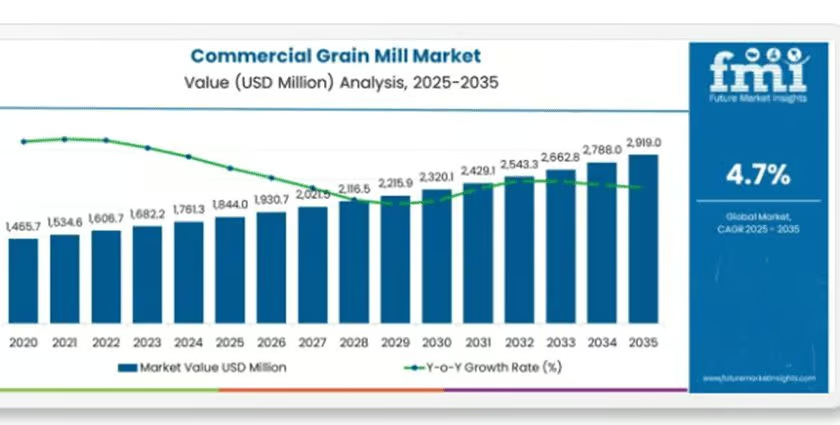
Centralized Data Platforms: Moving Beyond Conventional Automation
For many milling operations, automation once meant installing PLCs and linking them to a SCADA (Supervisory Control and Data Acquisition) screen in the control room. Operators could see alarms, start and stop machines, and monitor throughput. It was a major step forward at the time. But today’s competitive flour, feed and grain markets require more than visibility. They require intelligence. The shift is now clearly toward centralised data platforms that bring together every signal from the plant floor, from intake to packaging, and convert it into actionable insight. Leading technology suppliers are embedding this capability directly into their equipment and digital ecosystems.

At Bühler Group, the transition is visible through its Mercury MES and Bühler Insights platforms. These systems aggregate data from roller mills, purifiers, sifters and sensors into unified dashboards that track yield, energy use, downtime and quality deviations in real time. Combined with its SmartMill concept, temperature, vibration and energy data are continuously analysed to enable predictive maintenance and autonomous process adjustments. A similar integration approach is seen at Andritz AG through Metris Plant Insights. By building digital twins of processing lines, Andritz enables millers to simulate process changes before implementation. Machine learning tools detect anomalies early, reducing unplanned shutdowns and stabilizing production.
Turkish supplier Alapala combines its roller mills and plansifters with plant-wide automation systems that link cleaning, milling and packaging under a single control architecture. This ensures recipe management, traceability and KPI tracking operate seamlessly across departments.The same technology has been reported from Omas and IMAS, which have high-efficiency grinding systems equipped with real-time control sensors that optimise energy and extraction rates. Meanwhile, Henry Simon Milling integrates advanced sensor packages within its roller mills to capture grinding temperature, roll gap and load data, feeding centralized monitoring systems focused on consistent flour quality.
Asian manufacturers such as Pingle Group and Haiyun Grain Machinery are also embedding PLC-based controls with digital interfaces in roller mills, purifiers and cleaning systems, allowing easier integration into centralized dashboards. Such systems also calculate Overall Equipment Effectiveness (OEE), combining availability, performance and quality metrics into a single measurable indicator. For mills operating at 400 to 600 tonnes per day, even a one percent improvement in OEE can translate into significant annual production gains.
Intelligent Grinding Systems: Precision at the Core
Grinding remains the heart of flour milling, and digital integration is redefining how roller mills operate. Modern systems incorporate sensors that monitor roller surface temperature, vibration amplitude and bearing conditions. Automatic roll gap adjustment ensures stable grinding pressure even when wheat hardness varies.
Omas Industries has advanced this approach with its Leonardo roller mill, featuring direct-drive motors that eliminate traditional belt systems. Operating speeds are electronically controlled, reducing energy losses and enabling precise differential adjustments. The absence of belts reduces maintenance intervals and improves energy efficiency. Installed in several European and African mills, Leonardo systems report lower power consumption per tonne compared to conventional belt-driven mills.
Meanwhile, Satake Corporation integrates sensor-based monitoring within its grinding and sorting lines. Although widely recognized for rice technology, Satake’s flour milling installations incorporate real-time moisture measurement and impurity detection systems that feed data back into plant control software.
Optical Sorting and AI-Based Grain Cleaning
Downtime in the grain industry is costly. Improving reliability and enhancing safety with predictive maintenance supports operations and profitability. Accurate measurement of material flow and weights optimizes processes, reduces waste and promotes productivity. Before wheat reaches the roller mill, digital intelligence is already shaping quality control. Optical sorters now use multi-spectral cameras and artificial intelligence to detect foreign material and defective kernels.
Bühler’s SORTEX H SpectraVision system captures high-resolution imagery across multiple wavelengths, enabling precise rejection of ergot, fusarium-damaged kernels and foreign grains. These machines operate at high throughput while logging rejection rates and defect categories into centralized dashboards. The data can be analyzed to identify supplier trends or seasonal quality fluctuations. Satake’s optical sorting systems employ infrared and color imaging to detect impurities invisible to the human eye. In export-focused mills, such precision enhances compliance with international maximum residue limits and food safety standards.
In grain handling and storage, Ag Growth International integrates temperature cables, aeration controls and drying systems into digital monitoring networks that protect grain quality throughout storage cycles. Similarly, Cimbria connects its SEA.IQ optical sorters and silo monitoring systems to automation platforms that continuously track raw material condition and cleaning efficiency. Operationally, these systems process several tonnes per hour depending on configuration, with rapid data refresh rates that allow continuous adjustment without halting production.
“The grain storage industry is on the cusp of an intelligent revolution,” said Martino Celeghini, chief executive officer of CESCO. “Artificial intelligence is rapidly transforming how facilities operate, optimizing processes, maximizing efficiency and safeguarding grain quality. From predictive maintenance to automated quality assessment, AI is poised to significantly enhance every step of the grain storage cycle.”
Near-Infrared (NIR) Analysis: Real-Time Quality Control
Laboratory analysis traditionally delayed corrective action. In modern milling operations, manufacturers are investing in energy-efficient designs, digital control systems, and hygienic milling solutions to align with food safety regulations and sustainable production practices.
With embedded NIR sensors, mills now measure moisture, protein and ash content directly in the production line. Data feeds automatically into blending and tempering control systems. For example, automated tempering adjusts water addition based on live moisture readings, ensuring consistent conditioning before grinding. If protein levels fluctuate, blending strategies can be modified instantly to maintain flour specification.
While MES platforms provide analytics, the foundation remains robust PLC and SCADA infrastructure. Modern SCADA systems allow centralized visualization of thousands of data points, including motor currents, bearing temperatures and pneumatic pressures. Deviations trigger alerts before mechanical failure occurs. An example is Alapala supplied Pioneer Foods in Durban, South Africa, with an automated system combining SCADA control, NIR quality analysis and traceability modules. The digital architecture generates detailed batch records, supporting food safety compliance and export requirements. For mills serving multinational bakery clients, traceability is increasingly a contractual necessity. Beyond in-process detection during flour milling, rheological devices such as farinographs and alveographs have been designed to generate performance data that can be uploaded into MES platforms. Such integration reduces reliance on post-production corrections and minimizes out-of-spec batches. In large-scale operations, this translates into lower rework volumes and reduced quality-related waste.
Navigating Structural Challenges in Digital Milling
As digital technologies become embedded across flour milling operations, the industry faces a pivotal transition. While the operational benefits are increasingly measurable, improved extraction stability, reduced downtime, optimized energy use and enhanced traceability, the pathway to full digital maturity remains complex. The sector must now balance capital investment, workforce capability and cybersecurity risks against the promise of higher productivity and stronger margins.
One of the primary challenges is capital intensity. Advanced MES platforms, AI-enabled optical sorters, sensor-rich roller mills and integrated SCADA architectures require significant upfront investment. For mid-sized millers operating in cost-sensitive markets, return on investment must be clearly quantified. Energy savings of 10–15%, extraction improvements of 0.5–1.5%, and reductions in unplanned stoppages are compelling, but they demand disciplined data utilization to convert technical capability into financial performance.
Integration complexity presents another barrier. Many mills in Africa and emerging markets operate hybrid environments where legacy mechanical equipment coexists with modern digital systems. Retrofitting older lines to communicate with new platforms is not always straightforward. Compatibility between PLC brands, data protocols and cloud systems requires structured planning and skilled engineering support. Suppliers such as Bühler Group, Alapala, Omas Industries and İmaş Makina Sanayi A.Ş. increasingly emphasize modular upgrades to address this reality, yet execution remains site-specific.
Cybersecurity is emerging as a strategic concern. As mills connect machinery to cloud dashboards and remote diagnostics, operational technology becomes vulnerable to digital intrusion. A disruption in plant control systems could halt production or compromise quality assurance data. Consequently, secure network architecture and controlled remote access protocols are becoming as critical as mechanical reliability.
Workforce readiness also defines the pace of adoption. Digital dashboards and predictive maintenance alerts are only effective when operators and plant managers can interpret and act upon them. The transition from mechanical troubleshooting to data-based decision-making requires continuous training. Without this capability, digital tools risk being underutilized. Despite these challenges, the trajectory of the digital milling industry is clear. Over the next decade, several structural shifts are likely to shape its evolution.
By Martha Kuria, Food Scientist and Product Innovation Specialist.
This feature appeared in ISSUE 18 of MILLING MIDDLE EAST & AFRICA MAGAZINE. You can read this and the entire magazine HERE.

