

COUNTRY FOCUS: SOUTH AFRICA
South Africa‘s grain economy is anchored by maize, supported by a structurally constrained wheat sector and a rapidly expanding soybean industry.
South Africa’s grain economy: Navigating volatility across maize, wheat and soybean markets
Located at the southern tip of the African continent, South Africa plays a central role in regional grain supply, acting as both a surplus producer and a critical trade hub for neighbouring markets including Zimbabwe, Botswana and Namibia.
Agriculture contributes roughly 2-3% to national GDP but carries a significantly higher indirect weight through agro-processing and exports. The sector is dominated by large-scale commercial farmers, though smallholders remain a policy-relevant segment.
South Africa’s grain economy is anchored by maize, supported by a structurally constrained wheat sector and a rapidly expanding soybean industry.
Yet despite its relative sophistication, the system is increasingly shaped by climate volatility, rising input costs and persistent logistics inefficiencies. These pressures have intensified production swings, disrupted trade flows and tightened margins across the value chain.
Maize: Surplus producer under pressure
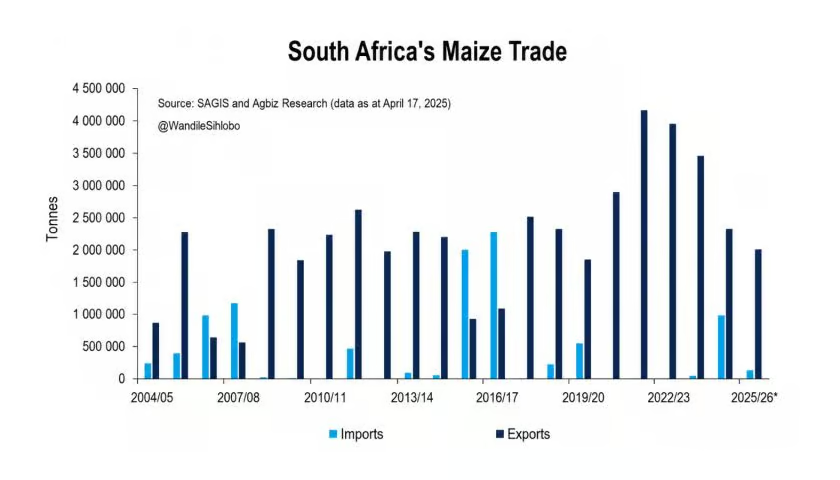
Maize remains South Africa’s most important grain, underpinning both food security and feed demand. The 2025-26 season has delivered a record harvest. The Crop Estimates Committee’s April 2026 data places production at 16.8 million metric tonnes (MMT), up from 16.44 MMT in 2024-25 and the largest maize crop on record. The recovery from the 2023-24 drought, which cut output by 22%, has been substantial, driven by expanded area plantings and favourable summer rains across the key producing provinces of Free State, Mpumalanga and North West.
South Africa produces both white maize for human consumption and yellow maize for the feed industry, with domestic demand covered comfortably by the current harvest. However, maize prices are already down 20-30% year-on-year. Writing in April 2026, Agbiz Chief Economist Wandile Sihlobo warned that while the large harvest should ease food price inflation, “external factors, particularly fuel costs, remained a risk to producer margins.”
Those input cost pressures remain acute. Fertiliser prices have risen around 11% year-on-year and diesel costs have climbed by approximately R3 per litre (approx. $0.18/litre) in 2025. Grain SA and FERTASA warn that South Africa’s dependence on imported fuel and fertiliser leaves producers exposed to global shocks. Ongoing tensions in the Middle East have unsettled energy markets, with Brent crude at times surpassing $100 per barrel, and nitrogen-based fertiliser prices have begun to follow.
Wheat: Structural deficit and policy friction
In contrast to maize, South Africa’s wheat sector is operating under sustained structural strain. Domestic production stands at approximately 2.03 MMT for the 2025-26 season, against annual consumption of around 4 MMT, leaving the country reliant on imports for roughly half its needs. The deficit is not new, but the outlook for 2026-27 has worsened. According to the Crop Estimates Committee’s planting intentions data, wheat area is expected to fall 6% to 486,400 hectares, the lowest planted area in 12 seasons.
Writing in his AgriView newsletter in April 2026, Sihlobo identified the sector’s core pressures as lower commodity prices, sharply higher input costs and an uncertain rainfall outlook, conditions he described as leaving the wheat industry as the most strained of South Africa’s five winter crops.
Imported wheat, predominantly from Russia and Ukraine, consistently undercuts domestic producers on price. South Africa’s variable import tariff system is designed to offer some protection, but in early 2026, the tariff dropped sharply from approximately $38/tonne (R619) to just $9/tonne (R153) following a reference price adjustment. Industry stakeholders have raised concerns over the pace of these adjustments, arguing that policy lag increases planning risk for local producers.
Soybeans: From import dependence to net exporter
South Africa’s soybean sector represents one of the more significant structural changes in the country’s agricultural economy over the past decade. As recently as the 2010s, over 80% of domestic soybean meal consumption was imported. The 2025-26 season is expected to close with a record harvest of 2.8 MMT, driven by expanded plantings and high yields, well above the domestic annual requirement of approximately 2.3 MMT. South Africa is now a net exporter, with 2025-26 export volumes estimated at 350,000 tonnes.
The sector’s growth has been sustained by strong crushing demand from the domestic animal feed industry and improving agronomic practices among commercial producers. In his AgriView newsletter, Sihlobo described the soybean industry as “one of South Africa’s success stories in agriculture,” noting that the sector is now consistently breaking production records. The challenge going forward is whether infrastructure and export logistics can keep pace with output growth, a constraint that applies equally to maize and soybean export volumes.
Logistics and milling: constraints on a commercialised system
South Africa’s grain value chain is supported by national silo capacity estimated at approximately 15 MMT, with major operators including AFGRI central to handling and storage. Despite this, the movement of grain from farm to port or processor remains a persistent constraint.
Road transport carries over 70% of grain volumes as rail infrastructure continues to suffer reliability problems, inflating transportation costs and straining road networks in key production regions. At the export end, South Africa’s major ports, particularly Durban and Cape Town, have ranked among the lowest performers globally on throughput efficiency. Container backlogs recorded in 2023 exceeded 60,000 units, resulting in missed export windows and higher costs for grain exporters. While Transnet has indicated improvement targets, port performance remains a structural risk for a sector that depends on export markets to clear surplus production.
The milling sector is highly consolidated, with Tiger Brands, AFGRI Milling, Miller Pride Milling and RCL Foods controlling approximately 85% of the market. Total milling capacity stands at around 5 MMT, running at 79.5% utilisation. Operations are concentrated in Gauteng, processing primarily maize meal and wheat flour for a stable, urbanising consumer base.
Future outlook: Balancing resilience and risk
South Africa’s grain sector remains one of the most developed in Africa, characterised by strong commercial capacity, established infrastructure and significant regional influence.
Maize is likely to remain a surplus crop, though production will continue to swing with seasonal weather. Wheat will remain structurally import-dependent, with deteriorating planting intentions signalling that the domestic supply gap may widen before it narrows. The soybean industry is breaking records, but logistics constraints limit how much of that output reaches export markets efficiently.
The sector’s long-term trajectory will depend on its ability to manage climate risk, improve logistics efficiency and sustain investment across the value chain. Without those adjustments, volatility will remain a defining feature of South Africa’s grain economy.
By Caroline Maina, Editor Feed Business Middle East & Africa
This feature appeared in ISSUE 19 of MILLING MIDDLE EAST & AFRICA MAGAZINE. You can read this and the entire magazine HERE.
