

Pasta consumption in West Africa
West Africa‘s pasta market remains underpenetrated relative to global benchmarks, but its growth rate places it among the most closely watched categories in the region’s food sector.
From side dish to staple: How pasta is reshaping diets in West Africa
“West Africa is not just adopting pasta, it is reshaping it to fit its own economic realities and cultural preferences.”
Pasta is steadily shedding its image as a Western import in West Africa, emerging instead as a practical, affordable, and increasingly essential component of everyday meals.
Across major markets such as Nigeria, Ghana, and Côte d’Ivoire, the category is evolving from a convenience option into a mainstream carbohydrate staple, driven by urbanization, shifting lifestyles, and strategic industry investments.
What is unfolding is not just a growth story, it is a transformation of consumption habits, supply chains, and product innovation across one of the world’s most dynamic food regions.
A high-growth market with untapped potential
West Africa’s pasta market remains underpenetrated relative to global benchmarks, but its growth rate places it among the most closely watched categories in the region’s food sector. In Nigeria, the region’s largest pasta market, the combined pasta and noodles segment is projected by Statista to reach approximately US$5.87 billion in 2025, growing at a compound annual growth rate of over 10% through 2030. For pasta specifically, IndexBox data places Nigeria’s market value at US$789 million in 2024, with a CAGR of 9.9% recorded between 2013 and 2024, the strongest sustained growth rate on the continent. Nigeria, Egypt, and Algeria together account for 52% of Africa’s total pasta market value. Ghana, while significantly smaller, recorded the fastest pasta import growth in Africa over the past decade, with import values rising at a CAGR of 41.5%, according to IndexBox data published in February 2026.
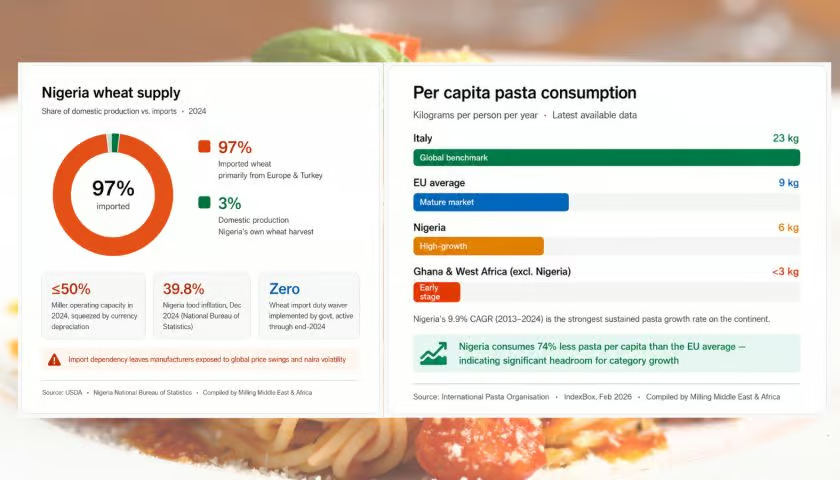
Per capita consumption tells a more nuanced story. Nigeria’s estimated 6 kg annually sits well below European averages, which exceed 23 kg in countries such as Italy and exceed 9 kg across the EU broadly, according to the International Pasta Organisation. That gap reflects both the early stage of category development and the scale of the commercial opportunity ahead for processors, traders, and distributors active in the region.
Urbanization, localization, and the rise of convenience eating
Rapid urbanization is the primary structural driver behind pasta’s growth across West Africa. As more consumers move into cities, household food choices are shifting away from labour-intensive traditional meals toward products that are quick to prepare and consistently available. In Ghana, where urban residents now account for over 59% of the national population and urbanization is growing at 3.06% annually according to World Bank data, this shift is already well advanced. Nigeria’s urban population is expanding at a comparable pace, with the country’s two largest cities accounting for a significant share of national pasta consumption.
Critically, West African consumers are not replicating Italian cooking. They are integrating pasta into existing culinary traditions, pairing it with tomato-based stews, spiced pepper sauces, and locally preferred proteins including fish and chicken. In Nigeria, stir-fried pasta preparations have gained significant traction, reflecting a practical fusion of global format and local flavour. Pasta is consumed primarily as a main meal, frequently substituting for or sitting alongside rice and cassava-based dishes.
Consumer research by Sagaci Research across the region identifies affordability, ease of preparation, and product familiarity as the three dominant purchase drivers. Spaghetti holds the largest share of consumption, while packaging format plays a material role in market access: smaller, lower-cost pack sizes are essential in lower-income segments and informal retail channels. Health considerations, including interest in whole wheat and fortified variants, are emerging among middle-income urban consumers, but remain secondary to price in most purchase decisions.
Supply chain shift: From imports to local production
West Africa’s pasta sector has historically depended on imported wheat, primarily from Europe and Turkey, leaving manufacturers exposed to global commodity price swings and persistent foreign exchange constraints. That exposure has sharpened over the past three years as currency depreciation and elevated freight costs have pressured input budgets across the region.
The response from both governments and industry has been a deliberate push toward domestic manufacturing capacity. Nigeria and Ghana are leading this transition, with several investments. The most significant industry response came from Olam Agri, which in March 2026 commissioned a US$40 million pasta production plant in Kpone, Ghana, with an annual capacity of 40,000 tonnes. In April 2026, the company launched First Choice Premium Spaghetti, the first pasta brand manufactured entirely within Ghana. Olam Agri’s regional presence traces to its 2019 acquisition of Dangote Flour Mills for approximately US$361 million, giving it five integrated flour and pasta manufacturing facilities across Nigeria.
Several processors are also evaluating cassava and sorghum as partial wheat substitutes. Research by Italy’s CREA Research Centre confirms blended formulations can improve nutritional content, though texture challenges remain in products that move significantly away from semolina.
Competitive dynamics and structural constraints
Manufacturers operating in West Africa’s pasta market face a consistent tension between growth opportunity and input cost pressure. Currency volatility has driven repeated cost increases, forcing manufacturers to choose between protecting margins and holding the price points that drive volume. Most have absorbed margin compression rather than risk losing shelf presence in informal retail channels where brand switching is rapid.
Product localization has proven more effective than price competition alone. Producers offering formats suited to local cooking methods, particularly thicker spaghetti variants compatible with stew-based preparations, have achieved stronger category penetration. Smaller pack sizes function as a deliberate access mechanism, enabling consistent volume in lower-income households that purchase frequently in small quantities.
Distribution depth is the decisive competitive variable. Companies with established last-mile systems and relationships with informal retailers hold a structural advantage that is difficult to replicate. The Olam Agri model, integrating wheat milling, pasta manufacturing, and distribution, reflects the understanding that margin and market share are won as much in logistics as in product quality. Pasta continues to compete with rice, fufu, and cassava-based staples carrying strong cultural familiarity and, in some markets, government price support. The realistic commercial trajectory is continued penetration as a complementary staple in urban households, where dietary variety is increasing alongside disposable income.
Conclusion: A market being redefined
Pasta’s journey in West Africa reflects a broader transformation taking place across the region’s food systems. What was once an imported convenience product is now becoming a locally adapted, widely consumed staple, particularly in urban markets.
As manufacturers respond to shifting consumer demands and governments push for greater food security, the category is entering a new phase of development. The interplay between affordability, innovation, and localization will ultimately define its trajectory.
For industry stakeholders, the message is clear: West Africa is not just adopting pasta, it is reshaping it to fit its own economic realities and cultural preferences.
By Alphonse Okoth, Senior Editor FW Brands MEA.
This feature appeared in ISSUE 19 of MILLING MIDDLE EAST & AFRICA MAGAZINE. You can read this and the entire magazine HERE.