

Nestlé backs new collective industry initiative to scale global regenerative agriculture
Nestlé has committed to advancing regenerative food systems at scale and aims to source 50% of its key ingredients from farmers adopting regenerative agriculture practices by 2030.

SWITZERLAND – Nestlé has pledged its support for the Regenerating Together Programme (RTP), a new industry initiative aimed at helping scale regenerative agriculture practices across global food supply chains, the company announced from its Vevey headquarters.
The programme, developed by the Sustainable Agriculture Initiative Platform (SAI Platform), provides a framework with practical implementation guidance, transition support, and new protocols to help improve consistency, credibility, and transparency in the adoption and verification of regenerative agriculture practices across supply chains.
It is supported by more than 40 other leading food and agriculture businesses and has been developed with input from farmers, agronomists, non-governmental organizations, academia and industry, while also being backed by environmental organizations such as The Nature Conservancy and Earthworm Foundation.
The initiative’s launch follows more than four years of cross-sector collaboration to develop a more practical approach to regenerative agriculture, including pilot initiatives across multiple farming systems.
Pascal Chapot, Vice President and Head of Agriculture at Nestlé, said regenerative agriculture shows great potential to strengthen supply chain resilience against climate change while improving farmers’ livelihoods, and that accelerating adoption requires practical, credible frameworks that can be applied consistently across the value chain.
He described SAI Platform’s programme as a significant step forward in simplifying implementation, building trust, and supporting meaningful impact at scale.
The move is widely seen as part of Nestlé’s response to mounting pressure to reduce Scope 3 emissions and supply chain risk.
Nestlé has committed to advancing regenerative food systems at scale and aims to source 50% of its key ingredients from farmers adopting regenerative agriculture practices by 2030, with dairy, cocoa and coffee expected to be central commodities under that target, given their weight in the company’s global supply chains.
The RTP announcement builds on a broader run of regenerative agriculture initiatives Nestlé has rolled out over recent months.
In January, the company launched partnerships with The Nature Conservancy and the youth learning platform Goodwall to build regenerative farming frameworks and attract young people to agricultural careers.
In April, Nestlé signed a four-year agreement with Soil Capital to expand regenerative practices across France, Belgium and the UK, supporting farmers growing wheat, corn, barley and sugar beet with agronomic guidance, digital monitoring tools and financial incentives tied to verified environmental outcomes.
Nestlé has said that nearly two-thirds of its greenhouse gas emissions stem from agriculture and land-use change outside its direct operations, underscoring why supply chain-level interventions such as the RTP are central to its climate strategy, alongside its broader target of cutting emissions by 50% by 2030 against 2018 levels.
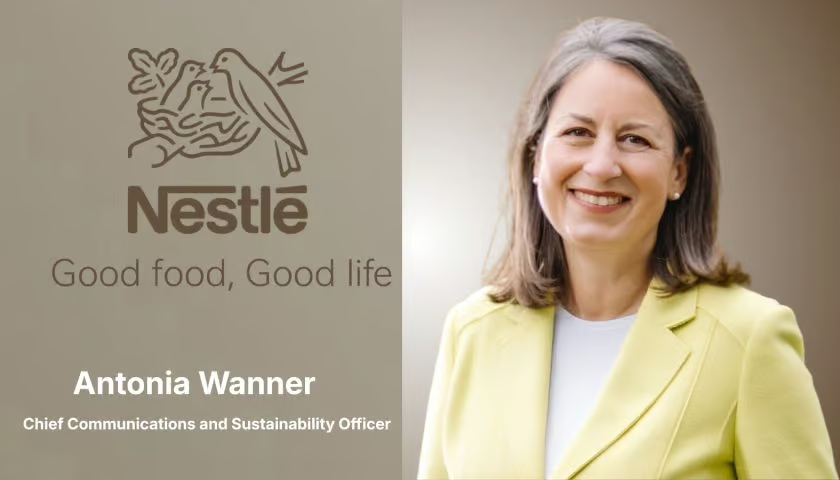
Additionally, Nestlé’s Board of Directors appointed Antonia Wanner, currently Chief Sustainability Officer, as Chief Communications and Sustainability Officer and a member of the Group Executive Board, effective 1 September 2026.
Sign up to HERE receive our email newsletters with the latest news and insights from Africa and around the world, and follow us on our WhatsApp channel for updates.