
Indonesia secures palm oil boost in landmark EU trade deal
The agreement includes a dedicated protocol on palm oil aimed at promoting sustainable trade.
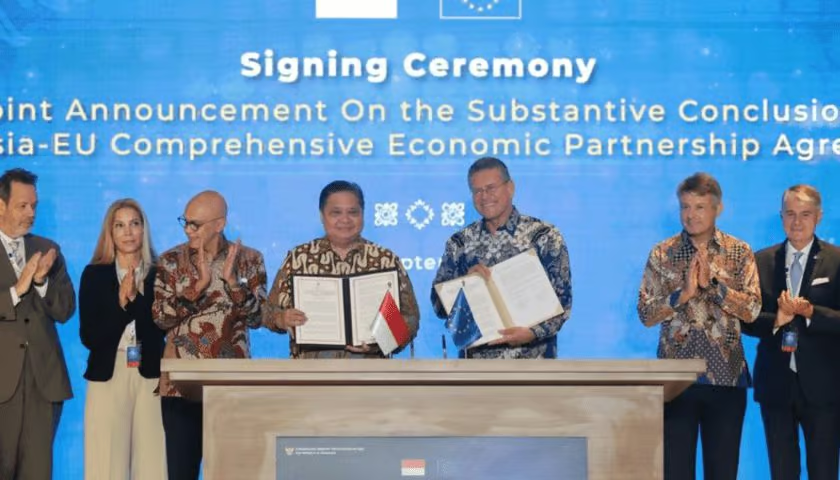
INDONESIA – The European Union and Indonesia have finalized a major free trade agreement known as the Comprehensive Economic Partnership Agreement (IEU-CEPA), which includes a significant boost for Indonesia’s palm oil exports to the EU by eliminating tariffs within a defined quota
The Indonesia-EU Comprehensive Economic Partnership Agreement (IEU-CEPA), finalized in Bali after nearly a decade of negotiations, is expected to reshape trade dynamics between Southeast Asia and Europe. This agreement is scheduled to take effect by 2027.
Under the deal, approximately 80% of Indonesia’s exports to the EU, including palm oil, textiles, footwear, and fisheries, will enter the bloc tariff-free.
This marks a significant shift for Indonesia, the world’s largest palm oil producer, whose exports have long faced scrutiny over environmental concerns.
The agreement includes a dedicated protocol on palm oil aimed at promoting sustainable trade.
It establishes a platform for dialogue on regulatory developments and encourages closer cooperation on sustainability standards.
EU Trade Commissioner Maroš Šefčovič hailed the deal as “a game-changer for both our economies,” while Indonesian officials emphasized its potential to double bilateral trade, which stood at US$30.1 billion in 2024.
However, the deal has sparked controversy among environmental groups and smallholder advocates.
Critics argue that the agreement reinforces extractive trade models and risks sidelining indigenous communities and small-scale farmers.
Fern, an NGO focused on forest protection, condemned the deal for lacking tangible benefits for marginalized groups and for potentially undermining the EU’s deforestation regulations (EUDR).
The EUDR, set to take effect in December 2025, requires companies to prove their supply chains are free from deforestation.
While large Indonesian exporters may meet these standards, smallholders who manage over 42% of the country’s palm oil plantations face significant hurdles.
Without clear national traceability systems, there are significant risks, including exclusion from EU markets despite tariff relief.
Indonesian Palm Oil Association chairman Eddy Martono welcomed the deal but warned that without compliance with EUDR, the zero-tariff advantage could be nullified.
As the EU considers another delay to the EUDR’s implementation due to technical issues, the trade pact’s success may hinge on Indonesia’s ability to align its sustainability practices with European standards.
For now, the IEU-CEPA opens a lucrative door, but one that demands careful navigation.
Sign up to HERE receive our email newsletters with the latest news and insights from Africa and around the world, and follow us on our WhatsApp channel for updates.