

China advances grain storage technology with next-gen inflatable silos
One of the key advancements of these silos is their rapid inflation capability, achieving full expansion in just 33 minutes, nearly three times faster than older models.
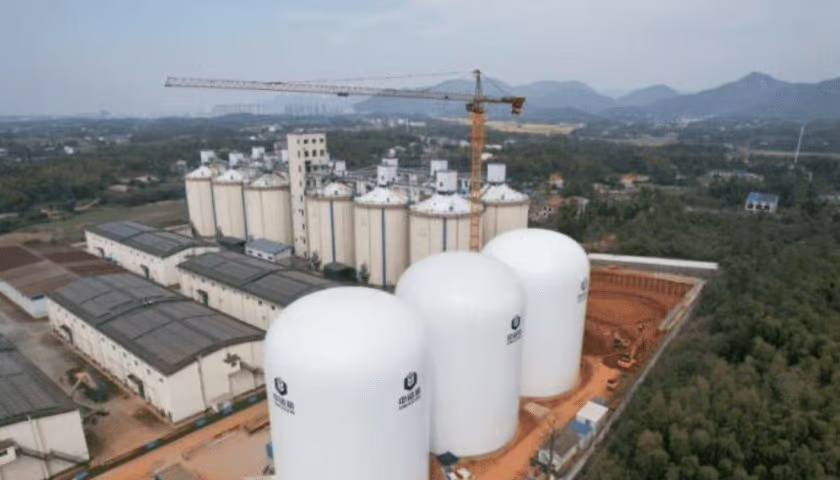
CHINA – China has completed the installation of three state-of-the-art inflatable grain silos in Hunan Province, each boasting a storage capacity of 9,000 metric tonnes.
Developed through a collaboration between China Grain Reserves Group (SinoGrain) and China National Coal Group, these new silos integrate cutting-edge technology to improve efficiency, durability, and storage capacity.
One of the key advancements of these silos is their rapid inflation capability, achieving full expansion in just 33 minutes, nearly three times faster than older models.
Standing 33 meters tall with a diameter of 24 meters, the new design also offers a 20% increase in storage capacity compared to previous versions.
The silos feature optimized warehouse dimensions, a hydrophobic and oleophobic membrane coating that enhances waterproofing and self-cleaning properties, and an upgraded intelligent air pressure electro-control linkage system that improves airtightness, thermal insulation, and overall structural integrity.
These innovations are designed to reduce post-harvest losses, maintain grain quality, and enhance the stability of China’s grain reserves.
China plans to expand its use of inflatable grain storage technology, with a total of five air-film silos expected to be operational in Hunan by the end of 2025.
This development is part of the country’s broader strategy to modernize its agricultural infrastructure and strengthen food security for its 1.4 billion citizens.
In 2024, China’s grain output reached a record high of 706.5 million tonnes, reflecting a 1.6% increase from the previous year. This marked the first time the country surpassed the 700-million-tonne milestone, reinforcing its commitment to food self-sufficiency amid evolving global trade conditions.
China’s investment in domestic grain storage and production comes as tensions rise in global agricultural trade.
The United States recently imposed an additional 10% tariff on various Chinese products, bringing the total tariff rate to 20%. In response, China’s commerce ministry announced retaliatory tariffs on US agricultural and food imports valued at approximately US$21 billion, including a 10% tariff on US soybeans and sorghum and a 15% tariff on wheat and corn.
Additionally, China has suspended import licenses for three major US agricultural exporters—CHS Inc., Louis Dreyfus Co. Grains Merchandising, and EGT, a company partially owned by Bunge Global SA—citing the detection of ergot and seed-coating agents in soybean shipments.
Against this backdrop, China’s advancements in grain storage technology are crucial for reducing reliance on foreign imports and mitigating potential supply chain disruptions.
The deployment of high-capacity, rapid-inflation silos is expected to significantly enhance grain storage efficiency and quality, ultimately supporting China’s long-term food security and economic stability.
Sign up to HERE receive our email newsletters with the latest news and insights from Africa and around the world, and follow us on our WhatsApp channel for updates.