
China injects US$250M to grow soybean, corn in Angola as it cuts US import dependence
60% of production is expected to be exported to China, with the remaining portion earmarked for local consumption.
ANGOLA – Citic Construction, a subsidiary of China International Trust and Investment Corporation (CITIC), has announced a US$250 million investment over the next five years to develop 100,000 hectares of farmland in Angola, marking one of the largest single Chinese agricultural investments in the country.
The move comes as Angola’s agricultural sector, which currently contributes around 10% to GDP while utilizing just 10% of its arable land, positions itself to reduce food imports, enhance food security, and diversify its oil-dependent economy. Angola has 35 million hectares of arable land, yet less than 5 million hectares are currently under cultivation.
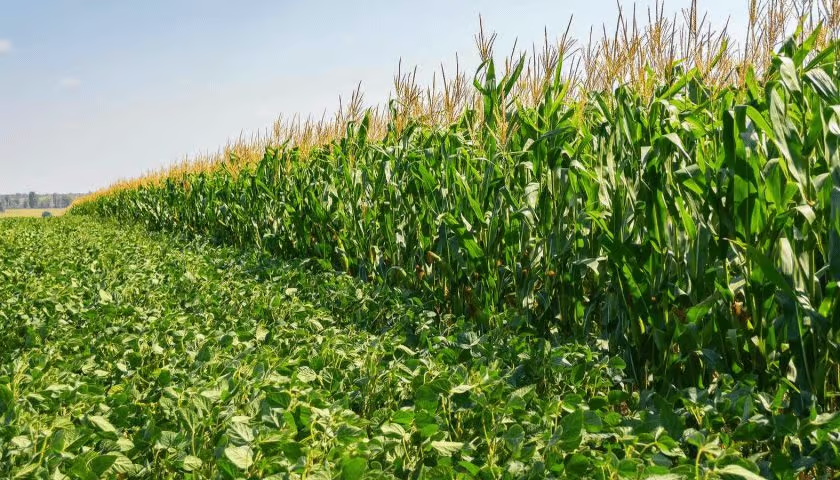
Fan Juntao, Citic’s general manager in Angola, confirmed on July 21 that the project will focus on soybean and corn production, with land clearing already underway on 3,000 hectares in Cuanza Norte and 5,000 hectares in Malanje.
The company expects to scale operations to 10,000–20,000 hectares by next year, applying high-yield technology to achieve eight tons of corn and five tons of soybeans per hectare.
This is significantly above the Sub-Saharan Africa regional average of 1.5–2.5 tons per hectare for maize and under 1 ton per hectare for soybeans, according to FAO data.
Citic will manage an agricultural support fund to facilitate mechanization and irrigation, aligning with Angola’s National Development Plan, which prioritizes increasing cereal and oilseed output while reducing a food import bill estimated at over US$2 billion annually, according to World Bank data.
The Angolan government has identified agriculture as a key diversification pillar, aiming to expand commercial agriculture and reduce dependency on oil, which still accounts for over 90% of exports.
However, approximately 60% of the soybeans and corn produced under Citic’s Angolan operations will be exported to China, with the remainder serving domestic markets to bolster local feed and food supplies.
According to Juntao, this investment aligns with China’s broader strategy to reduce its dependence on US soybean imports, which currently account for around 20% of China’s supply, amid ongoing trade tensions.
China imported 99.4 million tons of soybeans in 2024, with volumes from the US declining while African suppliers gain entry into the market, underscored by China’s recent approval on July 3 for the import of soybean meal from Ethiopia, expanding its African sourcing network.
The project is also expected to generate employment, develop rural infrastructure, and enhance technology transfer to local farmers, contributing to Angola’s food security ambitions.
Sign up to HERE receive our email newsletters with the latest news and insights from Africa and around the world, and follow us on our WhatsApp channel for updates.