
Nigeria unveils national palm oil traceability framework to cut US$600M import bill
The initiative marks a strategic pivot toward modernising the sector and reclaiming Nigeria’s status as a global palm oil powerhouse.
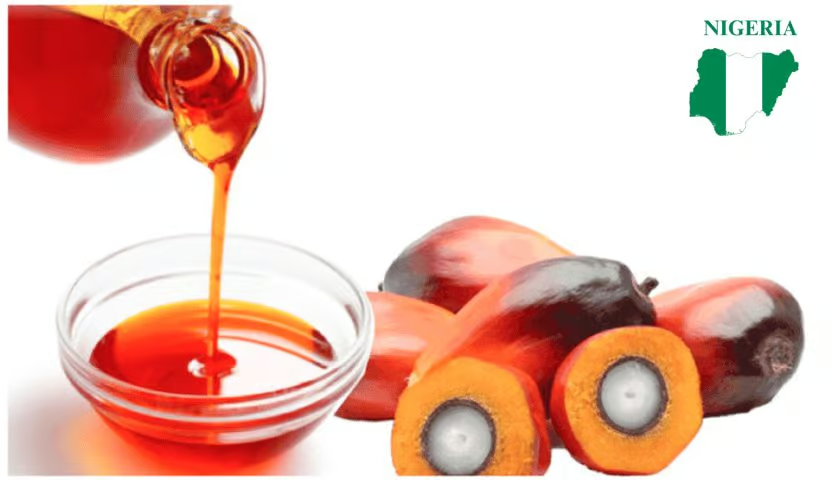
NIGERIA – In a bold move to revive Nigeria’s once-thriving palm oil industry, the Federal Government, in collaboration with Solidaridad Nigeria, has launched the National Palm Oil Traceability Framework and an Inter-Agency Committee to drive its implementation, aiming to slash the country’s staggering US$600 million annual import bill.
The initiative, unveiled in Abuja, marks a strategic pivot toward modernising the sector and reclaiming Nigeria’s status as a global palm oil powerhouse.
At the launch event in Abuja, the Ministry’s Permanent Secretary, Dr. Marcus Ogunbiyi, speaking on behalf of Senator Abubakar Kyari, Minister of Agriculture and Food Security, described the national palm oil traceability framework as a key step in Nigeria’s journey to restore its former prominence in the global palm oil industry.
“In the 1960s, Nigeria accounted for over 40% of global palm oil production. Today, our share has fallen to less than 2%, producing only 1.4 million metric tons against a national demand of over 2 million metric tons annually. This gap costs us more than $600 million every year in imports,” remarked Ogunbiyi.
Created in partnership with Solidaridad Nigeria, the newly launched framework establishes a comprehensive traceability system to guarantee that all locally produced palm oil meets high standards of quality, ethical sourcing, and transparency.
“Traceability is the language of the now and the future. Consumers and markets today demand to know a product’s origin and whether it meets ethical, health, and environmental standards. In the agriculture of tomorrow, traceability will not be optional; it will be a passport to success. A product without a story of origin will be a product without a market”, emphasised Ogunbiyi.
According to Solidaridad Nigeria, the framework would close gaps in Nigeria’s domestic arrangements and drive greater efficiency across the sector.
“Our inability to trace palm oil production to specific farms or processors has limited our productivity. With a robust traceability system, we will see more efficiency in production, processing, and marketing. This will position Nigeria to compete globally and cut down on imports significantly”, said Kene Onukwube, Program Manager at Solidaridad Nigeria.
Solidaridad Nigeria, with backing from the Netherlands and the UK, has successfully tested palm oil traceability systems in four Nigerian states: Akwa Ibom, Cross River, Enugu, and Kogi.
These pilot projects demonstrated that it’s possible to track palm oil from small-scale farms through processing facilities to export destinations, highlighting the practicality and potential impact of implementing traceability across the industry.
The framework aligns with Nigeria’s National Agricultural Technology and Innovation Policy (2022–2027) and President Bola Tinubu’s Renewed Hope Agenda, which prioritises agriculture as a central component of economic diversification and rural prosperity.
The newly inaugurated Inter-Agency Committee will oversee implementation, tackle technical challenges, and ensure alignment across federal and state institutions.
Stakeholders believe the initiative will not only improve food safety and transparency but also unlock investments in climate-smart oil palm production, boost farmer incomes, and enhance Nigeria’s competitiveness in regional and global markets.
With this framework, Nigeria is positioning itself to reclaim its position as one of the world’s leading palm oil producers.
Sign up to HERE receive our email newsletters with the latest news and insights from Africa and around the world, and follow us on our WhatsApp channel for updates.