
Black Sea tensions threaten global wheat supplies, raise risks for Africa
Black Sea tensions are putting fresh pressure on global wheat supplies, with disruptions to Russian and Ukrainian exports creating risks for import-dependent markets across Africa.
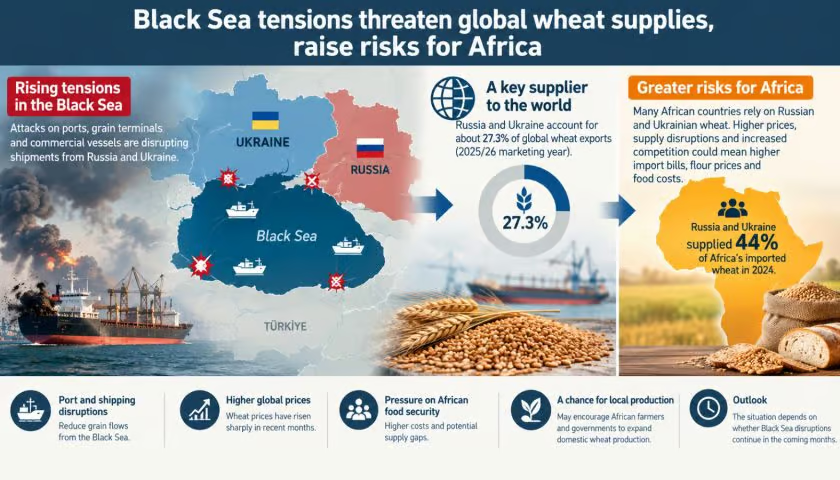
AFRICA – Renewed tensions in the Black Sea are creating fresh uncertainty for the global wheat market, with attacks on ports, grain terminals and commercial vessels disrupting shipments from Russia and Ukraine.
In this crucial piece for Milling Middle East & Africa, we examine the escalating crisis in the Black Sea and its immediate, far-reaching impact on the global grain trade. The article outlines how this geopolitical friction particularly threatens African nations which rely heavily on Black Sea grain, forcing millers and governments to navigate steep freight costs, hunt for expensive alternative origins, and confront rising domestic food security risks.
Russia and Ukraine accounted for about 27.3% of global wheat exports in the 2025/26 marketing year, making any prolonged interruption a major concern for import-dependent countries, particularly across Africa and the Middle East.
Wheat prices have already responded to the deteriorating security situation. The International Food Policy Research Institute (IFPRI) reported that global wheat prices had risen almost 25% above January 2026 levels by early August, reaching their highest level in two years.
The increase has been driven by a combination of Black Sea shipping disruptions, drought and declining production prospects among several major exporters.
The latest escalation has affected both Ukrainian and Russian export infrastructure. Russian strikes on ports around Odesa have disrupted Ukraine’s grain shipments, while Ukrainian attacks on Russian vessels and infrastructure have affected routes through the Sea of Azov and Black Sea.
The attacks on facilities in Novorossiysk, one of Russia’s main export hubs, also disrupted Russian grain logistics. In the first days of August, the port’s three grain terminals reportedly suspended operations, according to market participants cited by IndexBox.
In total, S&P Global estimated that 1.7 to 2.1 million tons of Russian exports were at risk for July and August, as well as approximately 500,000 tons of Ukrainian wheat scheduled for the same period.
Additionally, grain exports from Ukraine’s vital Black Sea ports dropped by 75% during the first two weeks of August compared to the same period last year, while shipments through important Russian routes were also been disrupted.
Threats on the African market
For Africa, the consequences could be significant because the continent relies heavily on imports to satisfy wheat demand.
Russia and Ukraine supplied approximately 44% of Africa’s imported wheat in 2024, with Russia representing the continent’s largest individual supplier.
On a continent where Russia has consolidated its presence in the wheat market over the past decade, Egypt remains arguably the most exposed African country, but it is not the only one: Sudan, Libya, Algeria and several sub-Saharan African countries are also affected, to varying degrees.
North African markets are particularly exposed. During the first half of 2026, more than 82% of Egypt’s wheat imports came from Russia and Ukraine, according to African Business.
Egypt, the world’s largest wheat importer, is already experiencing pressure from the disruption. S&P Global reported that wheat importers have faced tightening supplies and higher prices, with some buyers turning toward Baltic shipments as vessels become more reluctant to operate in the Black Sea. CIF East Mediterranean wheat prices reached about US$301 per tonne in late August, while freight costs also increased.
According to the US Department of Agriculture (USDA), Egypt imported 8.8 million tons of wheat between July 2025 and January 2026. Russia supplied 5.28 million tons, or 60% of the total, compared to 2.16 million tons from Ukraine and 1.12 million tons from the European Union (EU). This heavy reliance on Black Sea wheat puts Egypt in a particularly vulnerable position.
Navigating the threats and risks
The disruption is also forcing international buyers to seek alternative suppliers. Asian importers have recently increased purchases from Australia and Argentina, with some replacement cargoes priced substantially above Black Sea wheat.
Reuters reported that Chicago Board of Trade wheat futures had risen about 35% since late June as buyers sought alternative supplies.
Reuters reported on August 20 that French operators were preparing to ship a 67,000-ton cargo of wheat to Sudan, a market to which France had not supplied wheat for nearly two decades.
For African countries, increased competition for supplies could translate into higher import bills, flour prices and consumer food costs.
Governments that subsidize bread and other wheat-based staples may also face greater fiscal pressure.
At the same time, higher international prices could encourage African farmers and governments to expand domestic wheat production where climatic and irrigation conditions permit.
What room do African countries have?
The immediate outlook will depend heavily on the duration and intensity of the Black Sea disruptions.
Alternative suppliers, including Canada, the United States, Argentina, Australia and the European Union, could capture additional demand if Black Sea supplies remain constrained.
Canada is already seeking to expand sales to African markets where it competes with lower-cost Black Sea wheat.
However, longer shipping distances and higher-priced origins may limit how quickly importers can replace Russian and Ukrainian cargoes.
For African buyers, the outlook will depend on whether safe maritime corridors are restored, whether attacks continue, and whether competitively priced wheat is available from alternative origins.
Continued attacks could therefore keep wheat markets volatile and increase food-security risks across Africa.
Sign up to HERE receive our email newsletters with the latest news and insights from Africa and around the world, and follow us on our WhatsApp channel for updates.