
Uganda taps maize for biofuel as government seals partnership with Bukona Agro Processors
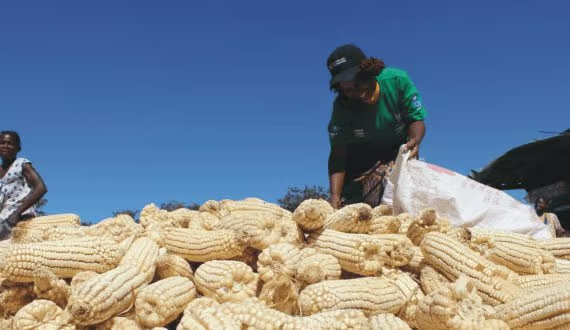
The programme will enable over 10,000 smallholder farmers from Nwoya District to supply 30,000 tonnes of maize annually

UGANDA – Uganda is set to begin using maize for ethanol production as part of its national Biofuels Blending Programme, following the signing of a Public-Private Partnership Agreement (PPA) between the Ministry of Energy and Mineral Development (MEMD) and Bukona Agro Processors Limited.
The agreement, formalised at Asinge ‘A’ Village in Malaba Town Council, Tororo District, will enable over 10,000 smallholder farmers from Nwoya District to supply 30,000 tonnes of maize annually. This maize will be processed into ethanol at Bukona’s new blending depot in Malaba, and later blended with petroleum motor spirit (PMS), commonly known as petrol.
The initiative is a major milestone under Uganda’s national energy strategy and the Biofuels Act, 2020, which mandates gradual blending of petrol with ethanol, beginning with a 5% ratio and scaling up to 20% over time.
Speaking on behalf of MEMD on July 18 Permanent Secretary Eng. Irene Bateebe, ministry official Mr Hatimu Muyanja said the agreement demonstrates how national energy policy can drive rural economic transformation.
“This partnership is a shining example of how our national energy policy, specifically the Biofuels Blending Programme, translates into tangible, life-changing benefits at the grassroots level,” said Eng. Bateebe.
Farmers participating in the programme, organised under Village Savings and Loan Associations (VSLAs), will have a guaranteed market for maize, cassava, and sugarcane, the three key feedstocks for ethanol production. This arrangement is expected to provide farmers with a predictable income stream and greater economic resilience.
Mr Praviin Kekal, Managing Director of Bukona Agro Processors Ltd, noted that the Malaba depot, built on 8.5 acres, represents an investment of between UGX 2.5 billion and UGX 3 billion (US$ 650,000 to US$ 780,000).
He confirmed that the company will continue sourcing raw materials directly from farmers in Nwoya District at pre-agreed prices and will collaborate with financial institutions like Centenary Bank to support access to agricultural inputs.
Kekal added that the facility is designed to blend approximately 450 million litres of petrol annually. At the initial 5% ethanol blend, the plant will require around 22 million litres of ethanol. Once Uganda adopts a 20% blend, annual ethanol demand could rise to 88 million litres.
The partnership also drew support from local government representatives. Mr Gerald Kyobe, Principal Assistant Secretary in Nwoya District, praised Bukona’s continued investment in the region, calling the new project a national milestone.
Energy Minister Ruth Nankabirwa had earlier announced that from July 1, Uganda would officially begin implementing its ethanol blending programme at the E5 level (5% ethanol).
Four facilities have been licensed to blend fuel near major border points: Modern Energy Ltd in Busia (49 million litres/month), Bukona Agro Processors in Malaba (48 million litres/month), Afro-Kai Ltd in Mutukula (6–8 million litres/month), and Lake Victoria Logistics in Entebbe (10 million litres/month).
Together, these depots are projected to blend roughly 110 million litres of petrol annually using ethanol derived from maize, cassava, and molasses. The government expects this initiative to reduce fuel import dependency, create rural employment, and offer smallholder farmers a sustainable market for surplus crop production.
Sign up to HERE receive our email newsletters with the latest news and insights from Africa and around the world, and follow us on our WhatsApp channel for updates.