

Turkey expects stronger wheat harvest as market pressures build
Turkey expects stronger wheat harvest as market pressures build.
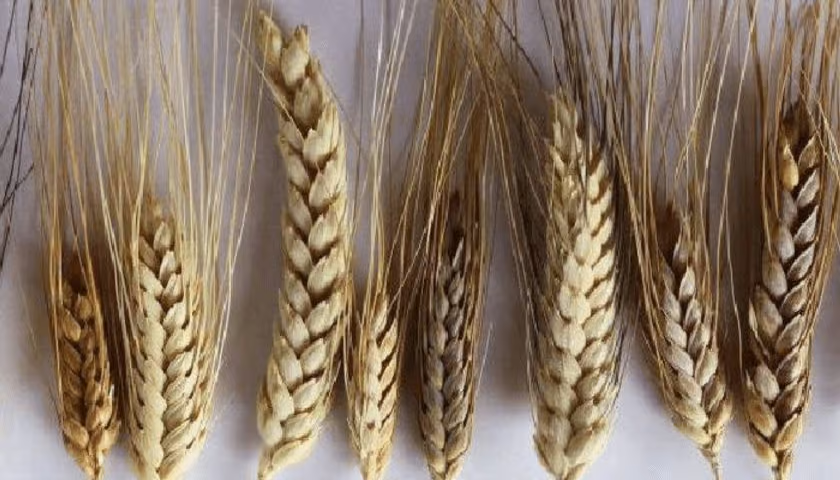
TURKEY – Turkey is heading into the 2026 harvest season with stronger wheat production forecasts, even as farmers and exporters face new pressures across the supply chain.
At a pre-harvest congress hosted by the National Grain Council in Konya, experts shared early projections that point to a solid recovery. Prof. Bayram Sade said wheat output could reach between 22.75 and 23.25 million tons if weather conditions remain stable through April and May.
He noted that winter rainfall exceeded long-term averages by 47 percent and more than doubled last year’s level.
Regional data shows gains across most parts of the country. Production could rise by up to 25 percent in Southeastern Anatolia and over 20 percent in the Mediterranean region. Other regions, including Central Anatolia and the Black Sea, are also set to post moderate growth.
Sade cautioned that rainfall alone will not secure high yields. He said soil quality, water retention, and farming practices will shape final results.
At the same time, planting patterns continue to shift. Prof. Süleyman Soylu said wheat area has grown to about 7.5 million hectares, up from 7.2 million last season. Corn planting has dropped by up to 15 percent nationwide, with sharper declines in Konya due to water shortages.
Farmers have also reduced cotton planting in the southeast, while more land is going into lentils.
Export risks and capacity concerns
These changes are already affecting processing industries. Aykut Göymen, head of the Turkish Pasta Manufacturers’ Association, said Turkey exports about 1.5 million tons of pasta, which makes up 26 percent of global trade.
Domestic demand stands near 700,000 tons. He warned that total capacity could reach 4 million tons, raising doubts about whether global demand can absorb the surplus.
“We face a real risk of excess supply if export markets tighten,” he said.
In the flour sector, Mesut Çakmak of the Turkish Flour Industrialists’ Federation said mills operate at only 45 percent capacity. He pointed to trade limits and payment challenges in key markets such as Iraq. “If conditions do not improve, exports could fall to around 2 million tons,” he said.
Global price pressure and supply risks
On the global market, prices remain under strain. Eren Günhan Ulusoy, Chairman of IAOM Eurasia, said wheat trades at about US$240 per ton, a level many producers struggle to sustain. “Prices look stable, but the balance remains fragile,” he said, noting that large supplies from Russia continue to weigh on the market.
Ulusoy added that energy, transport, and fertilizer costs now play a larger role in pricing. He warned that any disruption in key routes such as the Strait of Hormuz or the Red Sea could raise costs sharply, given that about 75 percent of global grain trade moves by sea.
Industry and government officials also flagged supply and input concerns. Ülkü Karakuş of the Turkish Feed Manufacturers’ Association said feed output has reached 30 million tons, with soybeans still a key import.
Agriculture Minister İbrahim Yumaklı said the country expects no fertilizer shortage and will maintain steady supply. TMO General Manager Ahmet Güldal added that storage facilities and licensed warehouses, now above 14 million tons, are ready for the new season.
Overall, the sector enters the harvest period with better crop prospects but rising pressure from costs, trade limits, and global market shifts.
Sign up to HERE receive our email newsletters with the latest news and insights from Africa and around the world, and follow us on our WhatsApp channel for updates.

