

Nigeria unveils US$3.5B post-harvest strategy to tackle food losses
Post-harvest losses in Nigeria have been estimated at nearly US$10 billion in 2024, according to official data.
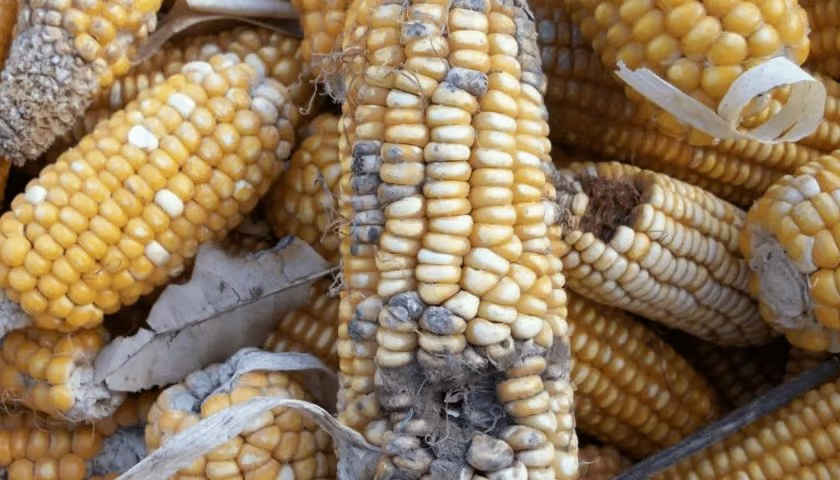
NIGERIA – The Nigerian government has unveiled the Nigerian Post-Harvest Systems Transformation (NiPHaST) program, a 10-year strategy designed to reduce post-harvest losses and strengthen the country’s food security.
Announced by Abubakar Kyari, Minister of Agriculture, during the 16th edition of the African Food Systems Forum (AFSF) held from August 31 to September 5 in Dakar, Senegal, the plan is expected to mobilize US$3.5 billion in investment with strong involvement from the private sector.
NiPHaST aims to modernize and expand Nigeria’s storage systems, ranging from household facilities to community warehouses and national strategic reserves. These will be developed and managed under public-private partnerships, with an emphasis on improving access to technologies such as solar-powered cold rooms, which remain underutilized.
“The NiPHaST program will help stabilize food prices, ensure the availability, accessibility, and affordability of staple foods, improve storage systems, and achieve national food sovereignty,” Kyari said.
According to him, the initiative will prioritize key value chains including cereals, pulses, roots and tubers, and vegetables, commodities most affected by high post-harvest losses.
According to official data, post-harvest losses were valued at nearly US$10 billion in 2024, undermining both farmer incomes and national food security goals. While NiPHaST seeks to address these gaps, structural obstacles remain.
The Food and Agriculture Organization (FAO) notes that cold chain development in sub-Saharan Africa is hampered by unreliable power supply, limited technical capacity for equipment maintenance, and high operational costs. Financing is another barrier.
“Nigerian banks have a poor understanding of the cold chain sector, which makes it difficult for players like us to obtain loans,” said Alexander Isong, president of the Organization for Technology Advancement of Cold Chain in West Africa (OTACCWA), speaking earlier this year.
As part of a raft of measures to ensure food security, recently, the Food and Agriculture Organization of the United Nations (FAO), in partnership with Nigeria’s Federal Ministry of Agriculture and Food Security (FMAFS), officially launched the 2025 Nigeria Food and Agriculture Policy Monitoring Review (PMR) in a high-level event held in Abuja.
This landmark initiative, developed under the framework of the National Agricultural Technology and Innovation Policy (NATIP), aims to drive evidence-based agricultural transformation to bolster food security, enhance yields, and promote sustainable development across Nigeria’s agrifood systems.
Sign up to HERE receive our email newsletters with the latest news and insights from Africa and around the world, and follow us on our WhatsApp channel for updates.