

IFAD, Partners launch pilot to boost maize and soybean value chains in Rwanda
The FARM P3 pilot will directly benefit up to 4,000 smallholder farmers, providing them with new opportunities to strengthen production and market access.
RWANDA – The International Fund for Agricultural Development (IFAD), together with the Rwanda Agriculture Board (RAB), cooperatives, private sector stakeholders, and development organizations including IDH, has rolled out the pilot phase of the Food and Agriculture Resilience Mission Pillar 3 (FARM P3) in Rwanda.
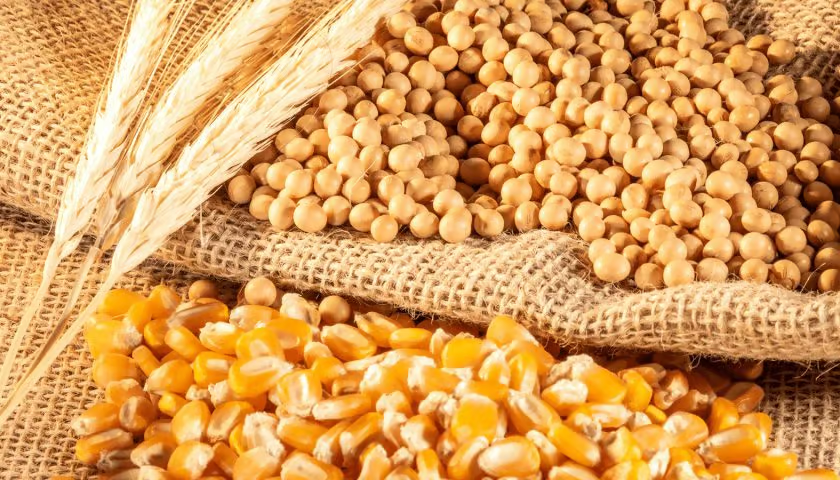
The initiative, which targets the maize and soybean value chains, seeks to strengthen food systems, reduce post-harvest losses, and raise incomes for smallholder farmers.
With a budget of US$1.23 million, the FARM P3 pilot will directly benefit up to 4,000 smallholder farmersin Kayonza District, by strengthening production and market access.
The programme complements the broader Kayonza Irrigation and Integrated Watershed Management Project, Phase II (KIIWP2), which supports over 40,000 rural households in achieving food security and climate resilience from 2021 to 2028.
“Through FARM P3, cooperatives, small and medium enterprises (SMEs), and banks will work together in a more structured way to foster win-win partnerships across key value chains,” said Dagmawi Habte-Selassie, IFAD Country Director.
“The focus is not only on training and equipment but also on building sustainable business relationships that ensure smallholder farmers can sell more, waste less, and increase their incomes,” he added.
A key goal of the pilot is to tackle maize post-harvest losses, currently at 13.8%. By co-investing in drying shelters for cooperatives and expanding access to mobile mechanical dryers for SMEs, FARM P3 will enable farmers to reduce grain moisture, meet private sector quality standards, and secure better prices.
This will provide buyers with higher-quality maize and lower sourcing risks, while farmers benefit from improved incomes and stronger market linkages.
Scaling up soybean production
The initiative is also laying the foundation for commercial soybean sourcing to meet growing private-sector demand. Activities include establishing demonstration plots, conducting inclusive business analyses, and investing in farm-level equipment.
According to Wangari Nduta, Project Manager of Business Analytics at IDH, adopting Good Agricultural Practices (GAP) and reliable market linkages could increase smallholder net incomes from soybean farming by up to 2.3 times over five years.
She added that soybeans already outperform traditional beans on average, making them an important driver of income diversification for rural households.
The initiative is part of Pillar 3 of the global FARM mission, first launched by France under the EU Council Presidency. The programme focuses on accelerating transitions toward sustainable and resilient food systems, particularly in Africa. FARM P3 is currently active in Senegal, Sierra Leone, and Zimbabwe, adapting to local contexts and specific value chains.
In Rwanda, the project aligns with the country’s PSTA 5 strategy, which prioritizes resilient, inclusive, and market-oriented agricultural value chains.
“By reducing post-harvest losses and fostering reliable market linkages, FARM P3 will contribute to advancing PSTA 5 priorities. It will empower smallholders while creating new investment opportunities for private sector actors,” said Solange Uwituze, Acting Director General of RAB.
Beyond infrastructure and training, FARM P3 is intended to promote systemic change by aligning farmers, buyers, and service providers around shared goals. The programme integrates nutrition, agriculture, and market development to enhance household food security while simultaneously creating profitable commercial opportunities across the maize and soybean value chains.
Sign up to HERE receive our email newsletters with the latest news and insights from Africa and around the world, and follow us on our WhatsApp channel for updates.

