COMMODITY UPDATE: Palm Oil in West Africa
The long-term outlook for palm oil in West Africa remains positive, supported by steady demand growth and continued investment across the sector.
The Renaissance of the West African Palm Oil Sector: Navigating Growth and Gaps
Palm oil is not merely an agricultural commodity in West Africa. The oil palm (Elaeis guineensis) is indigenous to the region, and its oil underpins food systems, personal care manufacturing, and industrial processing across the continent.
Global supply chains, foreign investment, and policy decisions now shape the market as much as the smallholder farmers working plots in Nigeria, Côte d’Ivoire, and Ghana.
The central tension is straightforward: West Africa holds some of the world’s most suitable land for oil palm cultivation, yet the region imported roughly 6.2 million tonnes of palm oil in 2024 to cover a demand that domestic production cannot meet.
Production gaps, trade flows, and the pace of investment will define how that equation shifts in the years ahead.
Production and the structural gap
West Africa sits at the centre of a clear supply imbalance. Across all of Africa, palm oil production reached approximately 3.4 million tonnes in 2024 against consumption of roughly 9.1 million tonnes, according to IndexBox, leaving a deficit of close to 5.7 million tonnes filled primarily by imports from Southeast Asia. Within West Africa specifically, total output stood at approximately 2.8 million metric tonnes in 2025, according to USDA data.
Nigeria leads regional production and ranks among the world’s top ten producers. Output reached between 1.4 and 1.57 million metric tonnes in 2025, though local markets absorb nearly all of it, leaving little available for export. Côte d’Ivoire follows as the second-largest producer, with crude palm oil output estimated at approximately 575,000 metric tonnes for the 2024-25 season, backed by a government ten-year investment plan targeting plantation rehabilitation and milling infrastructure. Ghana, Cameroon, Guinea, Sierra Leone and Liberia contribute additional volumes, though at a smaller scale.
Smallholder farmers drive the majority of production across the region, supplying between 70 and 90 percent of fresh fruit bunches in most producing countries. Limited access to improved planting materials, fertiliser and modern milling infrastructure, however, continues to suppress yields well below the benchmarks achieved by commercial plantation systems in Southeast Asia.
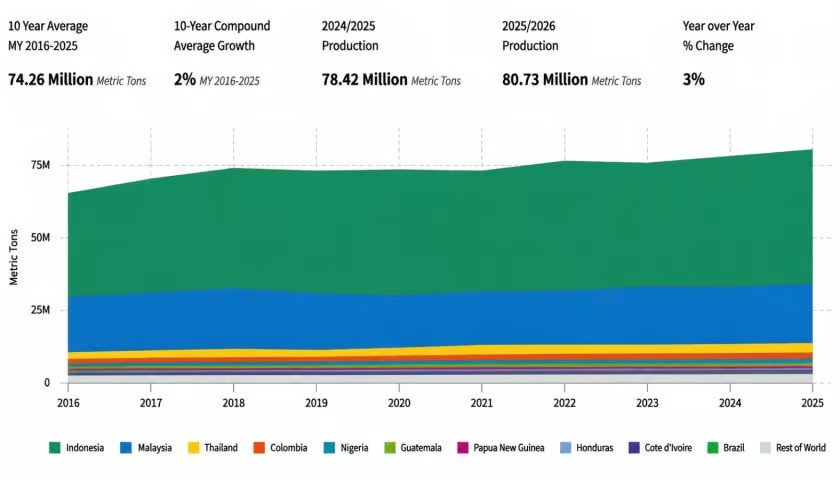
Source: Global Palm Oil production 2016 – 2025 by USDA
Market dynamics and industry structure
Trade flows reflect the region’s production constraints directly. Côte d’Ivoire has built the strongest intra-regional export position, shipping palm oil worth CFA 188.6 billion (approximately US$339 million) in 2024, with Burkina Faso and Mali accounting for more than 47% of that volume. Total African palm oil exports reached 1.1 million tonnes in 2024, up 48 percent year-on-year, with Côte d’Ivoire, Ghana, Liberia and Gabon among the leading sources.
The import side of the ledger tells a more structural story. Refined palm oil accounts for close to 80 percent of Africa’s palm oil imports, a ratio that reflects both strong consumer demand and the limited refining capacity that exists across the region. Most of the gap is filled by lower-cost refined product from Southeast Asia.
The ECOWAS Trade Liberalisation Scheme provides for duty-free trade in locally produced oil, but enforcement gaps persist. Origin fraud, where imported oil is relabelled as regional supply to access preferential treatment, remains a documented concern for trade regulators and domestic producers alike.
The formal industry is anchored by a small number of large operators. PalmCI, under the SIFCA Group, leads in Côte d’Ivoire, while Okomu Oil Palm Company and Presco PLC dominate Nigeria’s commercial sector. Wilmar International, Olam Agri and ADM connect local supply to global markets through integrated processing and trading networks. Government programmes are expanding alongside private investment: Nigeria’s 1.5 million hectare replanting programme, Ghana’s Redgold project, and Côte d’Ivoire’s ten-year plan all signal sustained public commitment to sector development.
Constraints and what holds output back
Productivity is the sector’s most persistent constraint. Yields across West Africa remain well below Southeast Asian benchmarks, a gap driven primarily by an ageing tree stock and limited adoption of improved varieties. Replanting programmes are underway in Nigeria and Côte d’Ivoire, but progress has been slow relative to the scale of the problem.
Processing infrastructure compounds the issue. A large share of fresh fruit bunches travels significant distances to reach functional mills, and delays between harvesting and processing directly reduce oil extraction rates and final product quality. Poor rural road networks amplify this problem across the producing belt from Guinea to Cameroon, keeping post-harvest losses high.
Cheaper refined imports from Southeast Asia continue to suppress domestic price levels, reducing the commercial incentive to invest in local farming and processing upgrades. Environmental compliance is also adding pressure. The EU Deforestation Regulation is tightening sourcing requirements for producers with export ambitions, requiring traceability infrastructure that most smallholder supply chains do not yet have in place.
Outlook and strategic direction
The long-term outlook for palm oil in West Africa remains positive, supported by steady demand growth and continued investment across the sector. IndexBox projects African consumption to reach 11 million tonnes by 2035, with a market value of approximately US$12.7 billion, making it one of the fastest-expanding regional markets globally.
Closing the productivity gap will determine how much of that demand the region can supply domestically. Without sustained progress in replanting, input access and processing capacity, output will continue to lag, and Southeast Asian imports will continue to fill the shortfall. The pace of government replanting programmes in Nigeria and Côte d’Ivoire will be closely watched by processors and traders over the next three to five years.
Traceability investment, driven partly by EU compliance requirements, is also beginning to generate data infrastructure that the wider industry can use. Better supply chain visibility improves procurement decisions, supports quality differentiation and opens access to premium export markets that have previously been closed to West African producers.
Beyond production, the next phase of growth will depend on value addition. Governments and private investors are placing greater focus on refining and downstream processing, including specialised fats and oleochemicals. Expanding these activities will allow countries to retain more value within the region and reduce dependence on imported refined product. A more integrated value chain is the strategic direction that will define the sector’s next decade.
By Stephen Kibe, Editor Milling Middle East & Africa Magazine.
This feature appeared in ISSUE 19 of MILLING MIDDLE EAST & AFRICA MAGAZINE. You can read this and the entire magazine HERE.