BAKING TECHNOLOGY: Effects of Damaged Starch in Baking
The commercial impact of starch damage management is most directly felt in dough yield.
Damaged starch is one of the most consequential yet least discussed quality parameters in wheat flour.
Produced when starch granules are physically fractured during milling, it directly influences water absorption, enzymatic activity, and dough rheology, affecting everything from fermentation behavior to crumb structure and shelf life.
Flour typically contains between 5% and 12% damaged starch by weight, a range wide enough to produce significantly different baking outcomes from otherwise identical recipes.
Optimal damage levels improve yield and hydration; excess damage creates processing problems that gluten quality cannot correct.
For mills across Africa and the Middle East, where blended grists from multiple wheat origins are the operational norm, managing damage level consistently is a daily practical challenge.
What is damaged starch and how does it form?
When roller mills physically fracture wheat starch granules, the granules lose their semi-crystalline structure, altering water uptake and enzyme access across the dough system. The single most influential factor determining damage level is wheat hardness. In hard wheat varieties including Hard Red Winter, Hard Red Spring, and Durum, starch granules are embedded in a dense, vitreous protein matrix that requires higher roller pressures to separate, increasing granule fracture. Soft wheat flour typically contains 1-4% damaged starch; hard wheat flour, 6-12%.
Roll settings are the primary lever millers use to manage damage within a given wheat type. A 2024 passage analysis across three commercial mills confirmed that damage increases progressively from initial to final milling passages, and that control is most effectively exercised at the front passages where the majority of flour release occurs.
Functional effects: water, fermentation, and crust
Damaged granules absorb water far more aggressively than native ones. Native starch granules absorb approximately 39-87% of their weight in water; damaged granules absorb 200-430%. Each unit rise in damage level increases flour water absorption by approximately 0.5%, enabling bakers to use higher hydration without additional raw material cost.
At optimal damage levels this supports better dough development and higher dough yield. Above that threshold, granules absorb water rapidly and release it just as quickly, overhydrating the protein network and producing sticky dough, poor gas retention, low loaf volume, and dense crumb.
In yeast-leavened products, damaged starch is the primary source of fermentable sugars beyond the 1-2% free sugars naturally present in flour. At moderate damage levels, enzymatic breakdown of damaged granules produces a steady maltose supply for consistent fermentation and good dough rise.
At excessive levels, rapid sugar release drives hyper-fermentation, destabilizes the gluten network, and risks oven collapse. Very low damage produces pale, under-colored bread, a visible quality failure that millers and bakers use as a routine diagnostic signal.
Optimal damage targets vary by product. Flatbreads including Arabic khubz and pita require tighter control than pan bread, as their thin profile and short bake time tolerate little over-hydration or fermentation imbalance. Biscuit and cracker flours sit at the low end of the damage range to preserve crispness. Millers supplying multiple product categories from one wheat source must actively manage roll settings to hit each specification.
Measurement: from lab reference to production control
Three methods measure damaged starch in common operational use. The enzymatic method, standardized under AACC 76-31.01, uses fungal α-amylase to hydrolyze damaged starch into glucose for quantification. It is the reference standard for research and formal contract specifications but requires skilled personnel and several hours per test, ruling it out for real-time mill management.
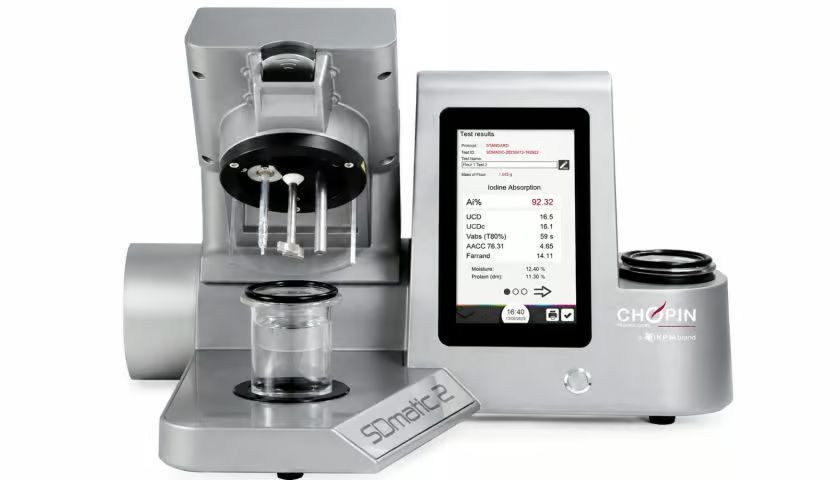
The amperometric method, the basis of the CHOPIN SDmatic 2, is the operational standard for routine testing. It measures iodine absorption by damaged granules in a diluted flour suspension, delivering a result from a 1g sample in under 10 minutes. The SDmatic 2 is compliant with NF EN ISO 17715:2015, ICC 172, and AACC 76-33.01, the standards millers reference in customer flour specifications.
NIR spectroscopy offers rapid non-destructive measurement but requires calibration against primary method data and revalidation when raw material sources change, a relevant discipline for mills managing variable import origins.
Implications for the Milling and Baking Industry
The commercial impact of starch damage management is most directly felt in dough yield. Increasing water absorption from 64% to 68% produces an additional 160 loaves of 250g each from 1,000 kg of flour, with no increase in raw material cost.
At larger scale, a higher-absorption flour specification can reduce flour consumption by approximately 27 kg per 6,500 loaves. These gains translate directly into margin improvement for millers supplying premium flour and bakers reducing input cost per unit.
The economics only hold within the optimal damage range. Excessive damage drives sticky dough, production line delays, equipment fouling, and product waste. In high-output operations those costs erase hydration gains quickly. Protein consistency across consignments does not guarantee baking performance; damage level does.
Research examining mills in South Africa, Turkey, and Algeria found that tuning roll parameters to hit target damage specifications, rather than maximum extraction rates, reduces electrical energy consumption as a direct consequence, a link that warrants active integration into mill management practice given the energy overhead facing most MEA operations.
Implications for millers in the Middle East and Africa
Starch damage management carries particular operational significance across the Middle East and Africa, where hard wheat dependency, import-reliant supply chains, and flatbread-dominant end markets combine to narrow the acceptable damage range for most flour specifications.
Most large mills in the region process hard wheat from the Black Sea, Australia, the United States, and Canada. Each origin carries a different hardness profile and starch structure, meaning roll settings calibrated for one consignment may produce significantly different damage levels when applied to the next. Without frequent measurement, millers supplying khubz, pita, and chapati producers are operating with limited visibility into a parameter that directly determines bakery performance.
A 2024 study in Engineering Proceedings confirmed that dry-climate wheat cultivation influences starch damage susceptibility during milling. Millers sourcing from these origins should treat damage level as a variable tied to origin and season, not only to roll settings.
In a nutshell
Starch damage will not become a simpler parameter to manage as supply chains grow more complex. Millers processing wheat from multiple origins, serving bakery customers with different product specifications, and operating under cost and energy pressure need to treat starch damage as a continuous production variable, not a periodic quality check. For mills across the Middle East and Africa supplying an increasingly specification-driven bakery sector, the question is no longer whether to monitor starch damage in real time, but how quickly to integrate that capability into standard operations.
By Stephen Kibe, Editor Milling Middle East & Africa Magazine.
This feature appeared in ISSUE 19 of MILLING MIDDLE EAST & AFRICA MAGAZINE. You can read this and the entire magazine HERE.