
Ceres Global Ag reports 110% drop in profit for Q2 2025 amid challenging market conditions

USA- Ceres Global Ag reported a staggering 110% decline in profitability for its fiscal second quarter ended Dec. 31, 2024, posting a net loss of US$379,000 compared to a net income of US$3.8 million in the same period last year.
The loss comes amid what the company described as challenging macroeconomic conditions and a difficult harvest season.
Revenue for the quarter also dropped 22%, falling by US$62.2 million to US$220 million, down from US$282.2 million a year ago.
Operating losses stood at US$407,000, a stark contrast to the US$3.7 million in operating income reported in the second quarter of fiscal 2024. Despite these financial setbacks, handle volumes increased by 12.5% year-on-year, reflecting robust operational activity.
Tom Coyle, interim president and chief executive officer, noted that Ceres managed to navigate the tough environment by leveraging its network of assets and expanding supply chain partnerships.
“By leveraging our network of assets and experienced team while expanding our supply chain partnerships, we were able to navigate the challenges of operating in a lower-margin environment,” Coyle said.
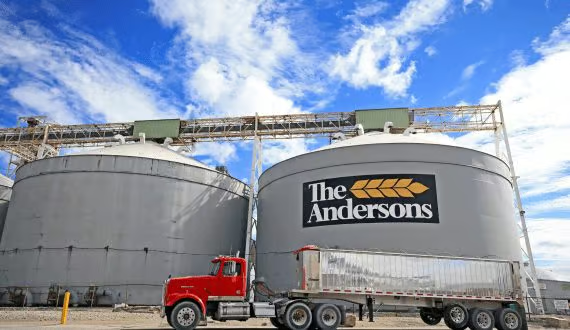
Ceres operates 10 facilities across Saskatchewan and Manitoba, Canada, as well as Minnesota, with a combined grain and oilseed storage capacity of approximately 29 million bushels.
The company also holds membership interests in three agricultural joint ventures, which collectively add another 16 million bushels of storage capacity.
A notable development in the quarter was the sale of Ceres’ Beausejour, Manitoba, facility, which closed on Nov. 14, generating a gain of US$316,000.
Meanwhile, Ceres’ Berthold Farmers Elevator joint venture performed well, contributing strong origination volumes. The company’s Supply Chain Services and Seed Retail segments also continued to gain momentum, delivering strong year-to-date volumes.
Jordan Mills, Ceres’ soybean crushing facility in Roland, Manitoba, remains a key part of the company’s operations.
The facility processes more than 2.7 million bushels of soybeans annually to produce express soymeal and soybean oil for Western Canada’s animal feed industry. Ceres remains optimistic about its local soybean sourcing strategy, which it sees as essential to maintaining high capacity utilization and securing adequate margins.
Growth in regenerative agriculture and future outlook
Regenerative agriculture remains a priority for Ceres as it builds strong relationships with its customer base to meet evolving consumer demand.
The company expanded its regenerative agriculture program significantly in 2024, increasing enrolled acres sixfold while maintaining a 100% retention rate among participating growers. As the 2025 planting season approaches, Ceres anticipates further growth in acreage and farmer participation.
Looking ahead, Ceres is closely monitoring the shifting trade landscape, particularly potential disruptions from U.S. trade policies under the Trump administration. The company is adjusting its trade strategies to adapt to potential changes in tariffs affecting the United States, Canada, and Mexico.
Additionally, as winter concludes, Ceres will track weather conditions and planting forecasts across the Corn Belt, Northern Plains, and Canadian Prairies to optimize its positioning for the remainder of the fiscal year.
For the first six months of fiscal 2025, Ceres reported an adjusted net income of US$1.76 million, down from US$9.1 million in the same period last year. Revenue declined 15% to US$422 million, driven primarily by lower commodity prices.
“Ceres remains committed to enhancing operational efficiency and fully realizing the potential of our assets while staying nimble to address changing markets,” Coyle stated.
Sign up to HERE receive our email newsletters with the latest news and insights from Africa and around the world, and follow us on our WhatsApp channel for updates.