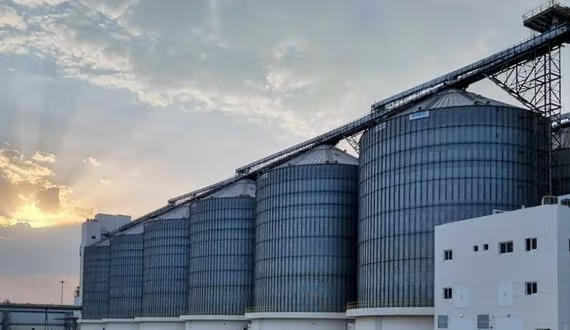

Grain SA sees tighter margins for 2026/2027 summer grain season
Lower grain prices and high input costs are set to keep pressure on farm returns as producers plan for the 2026/2027 season.
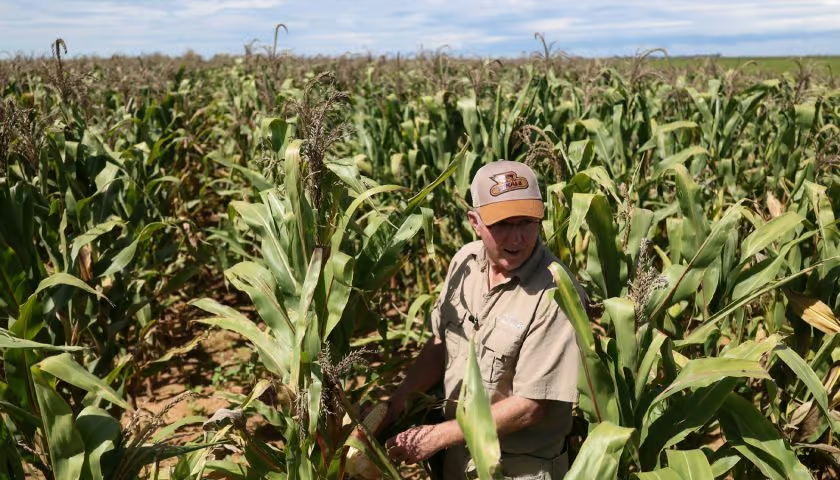
SOUTH AFRICA – Grain SA expects grain producers to face tighter margins in the 2026/2027 production season as commodity prices remain under pressure while input costs stay high.
The outlook also carries weather and global market risks, including the possible return of El Niño conditions and higher energy and freight costs linked to tensions around the Strait of Hormuz.
Grain SA’s latest production budgets compare maize, sunflower and soybean returns across South Africa’s summer rainfall regions. The organisation used five year average provincial yields from the 2020/2021 to 2024/2025 seasons to set expected yield levels.
The budgets use July 2027 forward prices of R3,800 (US$236) per tonne for white and yellow maize, R10,000 (US$620) per tonne for sunflower and R7,900 (US$490) per tonne for soybeans, based on an exchange rate of about R16.14 to US$1 on August 20, 2026. Handling, transport and marketing costs were then deducted to estimate farmgate prices.
Fertiliser remains the largest variable cost across many production systems, followed by seed, fuel, machinery repairs and crop protection products. In the Eastern Free State, maize fertiliser costs exceed R8,600 (US$533) per hectare, while the figure rises above R10,000 (US$620) in the eastern Highveld.
Sunflower shows stronger returns in several dryland regions. In the Eastern Free State, it remains the strongest crop on gross margin, while soybeans also record positive margins. Maize profitability depends more heavily on achieving strong yields and keeping costs under control.
Conditions become more difficult in western production areas, where lower rainfall limits yield potential. Maize variable costs fall to about R19,572 (US$1,213) per hectare in the North West Free State and R15,508 (US$961) in North West.
However, lower costs do not fully offset weaker income potential. Soybeans perform well in North West, recording a gross margin of R5,128 (US$318) per hectare.
Irrigated production carries the highest costs. Irrigated maize requires more than R53,000 (US$3,284) per hectare in variable spending and records a negative gross margin at current prices. Irrigated soybeans require R26,961 (US$1,671) per hectare and come close to breaking even before fixed costs.
Grain SA said the budgets should guide farm planning rather than serve as profit forecasts. “Every farming business is unique,” the organisation said, noting that actual returns will depend on yields, input costs, marketing decisions and market prices.
Overall, Grain SA expects grain profitability to remain weaker than in 2025/2026. Careful budgeting, cost control and realistic yield targets will remain important as producers make planting decisions for the new season.
Sign up to HERE receive our email newsletters with the latest news and insights from Africa and around the world, and follow us on our WhatsApp channel for updates.