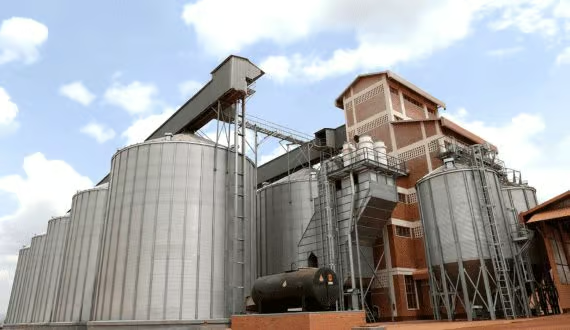

Zimbabwe to maintain maize import ban following bumper harvest
The move reverses the temporary lifting of restrictions last year to meet local consumption.

ZIMBABWE – Zimbabwe has reinstated a ban on maize imports, aiming to protect and promote local farmers following a robust harvest that has ensured sufficient domestic supply for the nation’s millers.
Government says it is satisfied with the steady flow of maize deliveries to the Grain Marketing Board (GMB). This move reverses the temporary lifting of restrictions last year amid severe food shortages caused by drought.
Speaking during a site visit to the GMB’s Aspindale Depot on Monday, August 25, Agriculture Permanent Secretary Obert Jiri said the board’s systems remain effective in managing quality control and storage of maize supplies.
To protect local farmers, Jiri confirmed that the government has shut borders to both public and private maize imports.
“Borders are closed to imports to ensure farmers have a secure domestic market. As long as local farmers still have maize, we won’t open the borders. Imports will only be considered once domestic supplies are fully exhausted,” he said.
The southern African nation, which consumes approximately 1.8 million metric tons of maize annually, the staple food for most of its 16 million people, experienced a sharp decline in output during the 2023/24 agricultural season.
Production dropped to around 800,000 metric tons from 2.3 million metric tons two years prior, largely due to an El Niño-induced drought that ravaged crops across the region. This shortfall forced the government to allow imports, including genetically modified maize, to avert widespread hunger.
In response to the crisis, more than half the population required food aid, and the country spent US$300 million in scarce foreign currency on maize imports in 2020 alone during a similar drought period.
This year’s turnaround has been attributed to improved rainfall patterns and government-backed initiatives.
According to the Zimbabwe National Statistics Agency (Zimstat), maize production for the 2024/25 season surged to an estimated 2.29 million metric tons, marking a 261% increase from the previous year.
However, the U.S. Department of Agriculture’s Foreign Agricultural Service provide a more conservative forecast of 1.3 million metric tons for the same period, highlighting potential discrepancies in yield estimates amid variable weather conditions.
Government initiatives enhance agricultural resilience
Jiri noted that the recovery, combined with state support programs, has built up adequate stocks to meet domestic needs without relying on foreign supplies.
A key driver of this resilience is the Pfumvudza/Intwasa scheme, a climate-smart agriculture program targeting smallholder farmers who make up the bulk of Zimbabwe’s rural population.
Launched to enhance food security and adapt to climate variability, the initiative promotes conservation farming techniques such as zero-tillage, mulching, and precise planting in small plots. Under Pfumvudza, a 0.125-hectare plot can yield between 625 kg and 1,500 kg of maize, significantly boosting productivity while conserving water and improving soil health.
Zimbabwe’s agriculture sector, which employs about 70% of the population and contributes roughly 15-20% to the GDP, remains highly susceptible to climate change.
Experts warn that rising temperatures, increased rainfall variability, and more frequent extreme weather events are exacerbating challenges for smallholder farmers in semi-arid regions.
Independent analyst Paul Chidziva echoed these concerns, stating that while the current surplus offers a “rare opportunity” to strengthen food security, the sector’s dependence on rain-fed farming leaves it exposed to future disruptions.
In response, the government is actively promoting drought-tolerant crops such as sorghum and millet, alongside investments in irrigation infrastructure.
Sorghum production, for instance, is projected at around 82,000 metric tons for 2024/25, providing alternative staples that require less water. Initiatives like the Green Climate Fund-supported project aim to build resilience in vulnerable agricultural livelihoods, focusing on water management and sustainable practices to mitigate long-term climate risks.
Jiri highlighted that the import ban not only supports farmers but also conserves foreign exchange reserves, which are critical for Zimbabwe’s economy amid ongoing challenges like hyperinflation and currency shortages. By reducing reliance on imports, the country hopes to foster self-sufficiency and stabilize food prices for consumers.
Sign up to HERE receive our email newsletters with the latest news and insights from Africa and around the world, and follow us on our WhatsApp channel for updates.