

Zimbabwe sets up 2,000 grain collection points to support bumper harvest, boost rural delivery efficiency
The delivery points aim to alleviate farmers from the burden of long travel distances to central depots
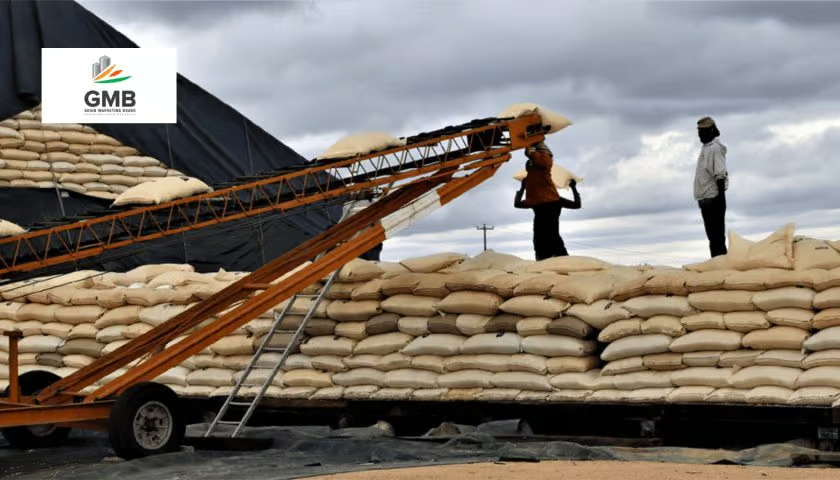
ZIMBABWE – The Grain Marketing Board (GMB) has established nearly 2,000 grain collection points across Zimbabwe to facilitate crop delivery and strengthen national food security, following one of the country’s most abundant harvests in recent years.
The decentralisation effort is aimed at reducing transport costs for farmers, minimising post-harvest losses, and ensuring timely grain intake from the 2024/2025 summer cropping season. The setup also responds to long-standing logistical challenges faced by rural producers.
According to the Second Round Crops, Livestock and Fisheries Assessment Report (CLAFA-2), the area under maize rose from 1.72 million hectares to 1.83 million hectares, translating to an estimated 2.29 million tonnes of maize.
Traditional grains, including sorghum, pearl millet, and finger millet, are expected to yield a combined 634,650 tonnes, bringing total cereal output to approximately 2.93 million tonnes.
This output surpasses Zimbabwe’s annual consumption requirements, positioning the country for a potential surplus of up to 1.2 million tonnes, depending on final use.
To ensure efficient grain handling, GMB has rolled out delivery points across all provinces, with the Midlands receiving the highest number at 372, followed by Masvingo (226) and Manicaland (224).
As reported by The Herald, this reorganisation aims to alleviate the burden of long travel distances to central depots, which has historically increased operational costs for smallholder farmers.
“This expansion of our grain collection points is a game-changer for our farmers and for national food security,” said Professor Obert Jiri, Permanent Secretary in the Ministry of Lands, Agriculture, Fisheries, Water and Rural Development.
Prof Jiri reiterated that the move significantly reduces the burden on farmers, cutting down on transport costs and minimising post-harvest losses, which is critical for maximising our yields from the summer cropping season.
According to him, favourable weather conditions contributed significantly to the successful harvest. While some farmers have completed harvesting and are preparing for winter cropping, others are currently drying grain ahead of delivery.
The rollout of the collection points follows the government’s recent commissioning of its first-ever Artificial Intelligence (AI)-powered Grain Marketing Board (GMB) silos in Kwekwe.
The seven-silo complex has a storage capacity of 56,000 tonnes and is equipped with digital systems that monitor temperature, moisture, and CO₂ levels in real time.
The Kwekwe site is the first of 14 similar complexes planned across key grain-producing regions, including Masvingo, Gokwe, and Mutare, with each facility expected to accommodate around 8,000 tonnes.
The facility, launched as part of the government’s Vision 2030 agenda, is designed to reduce grain spoilage, improve quality preservation, and support the management of national reserves. Officials say the modern silos can store grain for up to two years and reduce post-harvest losses that have cost the country over US$30 million annually.
Sign up to HERE receive our email newsletters with the latest news and insights from Africa and around the world, and follow us on our WhatsApp channel for updates.