

Turkish milling machinery exports grow by 5% in 2024
Experts are targeting a 20% increase in the sector for 2025.
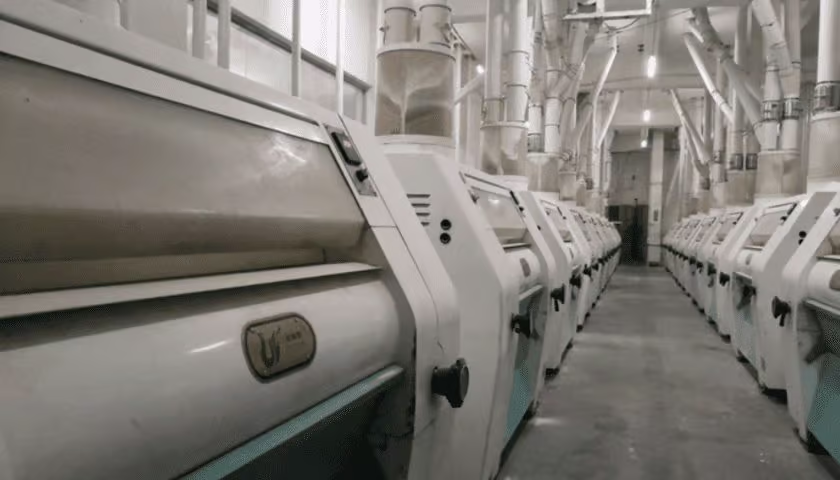
TURKEY – According to Zeki Demirtaşoğlu, Chairman of the Turkish Milling and Sector Machinery Manufacturers Association (DESMÜD), the Turkish milling machinery sector increased its export volume by 5%, reaching US$3.7 billion.
Demirtaşoğlu stated that their initial target was to achieve a 10-15% growth in exports, but they fell short due to global inflation and market contractions. Nevertheless, he praised the 5% increase, from US$3.5 billion to US$3.7 billion, as a significant milestone for the industry.
Demirtaşoğlu listed several challenges negatively affecting the country’s milling machinery exporters, including issues in production, transportation, and financing, along with geopolitical tensions and dollar shortages.
He also pointed to long-term, low-interest loans provided by countries like China and Germany, which have intensified global competition. He highlighted that 2024 has been particularly challenging for international trade and logistics.
“The crises in the Gulf of Aden, the Suez Canal, and the Panama Canal have significantly disrupted maritime trade. Additionally, the ongoing conflicts in Ukraine, Russia, Israel, Palestine, and Syria have been key factors contributing to market contraction in the sector.” Demirtaşoğlu said.
Despite these challenges, Turkish milling machinery manufacturers have improved their production quality by leveraging Industry 4.0 and 5.0 technologies, noted Demirtaşoğlu.
He acknowledged that Turkey continues to produce high-tech machines for the global market. Turkish manufacturers, especially in the milling machine sector, have maintained a strong position by developing superior-quality machines that incorporate advanced technology and are difficult to replicate.
Demirtaşoğlu added that this year’s aim is to increase the sector’s exports by 15-20%. He emphasized that even greater success can be achieved in the Turkish milling machinery sector with the launch of the Grain and Grain Products Innovation Centre project, led by DESMÜD.
However, the Chairman of DESMÜD expressed concern that one of the most significant risks the industry will face in 2025 is the continuation of wars and geopolitical tensions.
In particular, ongoing transport challenges and potential crises in critical waterways like the Suez and Panama canals could adversely affect global trade.
He also mentioned that the strategic decisions made by the new U.S. President Trump will influence the sector, highlighting that U.S. global policies will be crucial in shaping world trade.
Sign up to HERE receive our email newsletters with the latest news and insights from Africa and around the world, and follow us on our WhatsApp channel for updates.