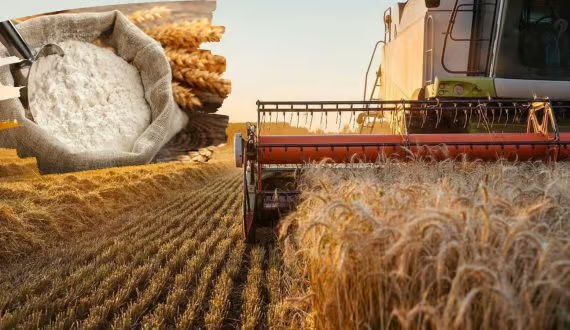

Ethiopia secures US$2.3M Japan grant to mechanize rice sector
Ethiopia imports about 80% of the rice it consumes, while the government aims to reach 1.93 million tonnes of paddy rice output by 2030.
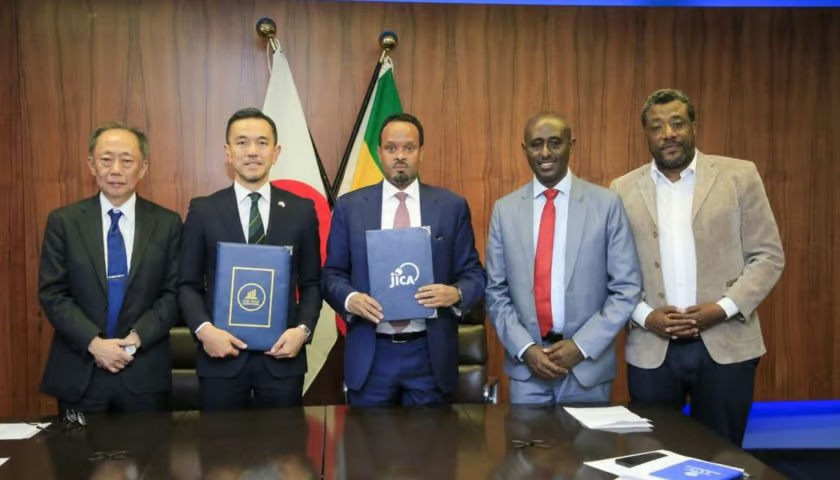
ETHIOPIA – Ethiopia and Japan have signed a JPY360 million (US$2.3 million) grant agreement to accelerate mechanization and modernization of the country’s rice sector through the provision of agricultural machinery and equipment.
The agreement will finance agricultural machinery and equipment intended to increase rice productivity, improve processing efficiency and reduce post-harvest losses.
The grant will support the procurement of combine harvesters, tractors, rice-milling machines and land-preparation equipment.
The equipment is expected to strengthen activities across the rice value chain, from field preparation and harvesting to processing, while helping farmers and processors improve operational efficiency.
Japan’s Ministry of Foreign Affairs said the assistance is expected to boost rice productivity and improve food security in Ethiopia.
The agreement was signed by Ethiopia’s Minister of Finance Ahmed Shide, Japan’s Ambassador to Ethiopia Shibata Hironori and Hiroyuki Yakushi, Chief Representative of the Japan International Cooperation Agency (JICA) Ethiopia Office.
The signing further strengthens cooperation between the two countries in agricultural development and food security.
Ethiopia is seeking to expand domestic rice production as consumption has increased in recent years.
Japan’s Ministry of Foreign Affairs said rice demand has grown following disruptions and economic difficulties that contributed to higher prices for teff, a major staple grain in Ethiopia.
However, domestic rice production has not kept pace with demand, with the country’s rice self-sufficiency rate estimated at about 20%, increasing the need for imports.
Mechanization is therefore being positioned as an important component of Ethiopia’s strategy to close the production gap.
The country’s National Rice Flagship Programme identifies improved access to mechanization tools, equipment and services as a priority for expanding rice production.
It also highlights the need to develop local manufacturers and mechanization service providers while improving training in the operation and maintenance of agricultural machinery.
Production rises but remains far below target
Ethiopia has sharply increased rice production over the past decade. Ministry of Agriculture data show that paddy rice output nearly tripled to 276,000 tonnes in 2021 from 97,000 tonnes in 2012.
Over the same period, farmers expanded the area planted with rice to 88,000 hectares from 34,000 hectares.
Under the second National Rice Development Strategy, or NRDS-II, which covers 2019-2030, Addis Ababa aims to raise paddy rice production to 1.93 million tonnes by 2030 and achieve self-sufficiency.
However, mechanization represents only one part of that effort. Authorities also identify weak irrigation capacity, limited access to credit, shortages of skilled personnel, land fragmentation and insufficient access to suitable equipment as structural constraints on the industry.
The latest grant builds on JICA’s longer engagement in Ethiopia’s rice sector.
Sign up to HERE receive our email newsletters with the latest news and insights from Africa and around the world, and follow us on our WhatsApp channel for updates.