
Traders raise alarm over rising non-tariff barriers crippling East Africa’s grain trade
Despite the region’s surplus production in key grains, trade has become increasingly challenging due to regulatory restrictions.
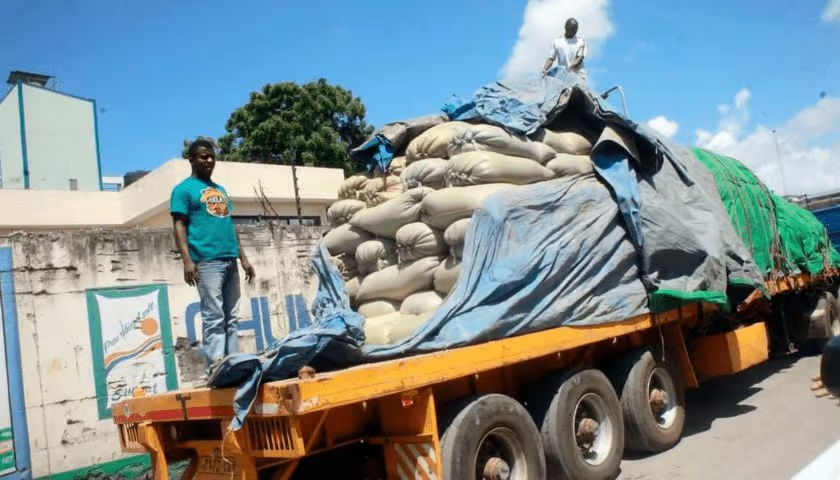
EAST AFRICA – Traders and agricultural stakeholders are raising alarm over rising non-tariff barriers (NTBs) across the East African Community (EAC), warning that mounting restrictions are severely disrupting grain flows, inflating prices, and compounding food insecurity across the region.
Despite the EAC’s long-standing commitment to regional integration, authorities in member states, Kenya, Uganda, Tanzania, Rwanda, Burundi, South Sudan, and the Democratic Republic of Congo, continue to impose regulatory constraints that hinder the free movement of grains such as maize, beans, rice, and sorghum.
These NTBs come at a time when seasonal food shortages, climate-related shocks, and growing refugee populations are straining already fragile food systems.
Stakeholders say the increased costs and delays associated with NTBs are pushing small and large-scale exporters to reconsider regional trade.
In Uganda, a newly introduced US$10 per metric tonne levy on wheat bran, maize bran, and cotton cake, implemented in the current financial year, is raising costs for regional buyers.
While the government defends the move as a strategy to encourage domestic value addition in the livestock feed industry, Kenyan feed millers and importers are bearing the brunt, given their reliance on Ugandan raw materials.
Tanzania’s export permit regime is another sticking point. Authorities are selectively issuing export licenses for grain, resulting in logistical bottlenecks for foreign buyers.
“Foreign traders used to drive directly to the farms, purchase produce, and transport it to Kampala using Ugandan trucks,” said Isaac Kashaija, chairman of the Uganda Rice Business Association.
According to him, traders have to wait at the Mutukula border or in Kampala for Tanzanian drivers to deliver. As a result, prices for Tanzania’s Super rice variety in Kampala have surged from Ush4,000 (US$1.11) to Ush5,000 (US$1.39) per kilogram.
Meanwhile, South Sudan has introduced some of the most burdensome trade measures. Since April 2025, exporters are required to comply with a Regional Cargo Tracking System and obtain an electronic permit, with upfront payments of US$3,000 per e-permit and US$150 per container.
Traders report repeated grain retesting and cargo delays at the Nimule border, with trucks often turned away over aflatoxin concerns.
Sudi Mwatale, chairman of the regional truck drivers association, expressed frustration, noting that theyhave protested these fees and clearance delays at Nimule, but their complaints are being ignored.
In April alone, South Sudan turned away eight trucks over aflatoxin contamination, while reports from previous years show a continued trend of rejections, 74 trucks were impounded in 2023 on similar grounds.
These actions are occurring as the country grapples with acute food insecurity; between April and July 2025, over 31,000 returnees in South Sudan were projected to face critical hunger levels.
Compounding the problem is ongoing political instability. The March 2025 house arrest of Vice-President Riek Machar has intensified insecurity, with traders reporting attacks along key transit routes.
The cumulative effect of these non-tariff barriers is visible in Uganda’s grain export data. According to the Bank of Uganda, maize exports fell by 56% year-on-year to 248,413 tonnes by May 2025. Bean exports declined from 106,344 tonnes to 83,734 tonnes, and sorghum dropped to 57,795 tonnes, down from 74,972 tonnes a year earlier.
Regional trade experts are warning that unless EAC member states urgently harmonize policies and remove barriers to trade, the bloc’s ambitions for a unified agricultural market will remain out of reach.
Sign up to HERE receive our email newsletters with the latest news and insights from Africa and around the world, and follow us on our WhatsApp channel for updates.