
Nigeria to strengthen food security under AgriConnect by 2031
The program targets a 30% increase in rice, maize, and wheat yields, while cassava yields should rise by 35%.
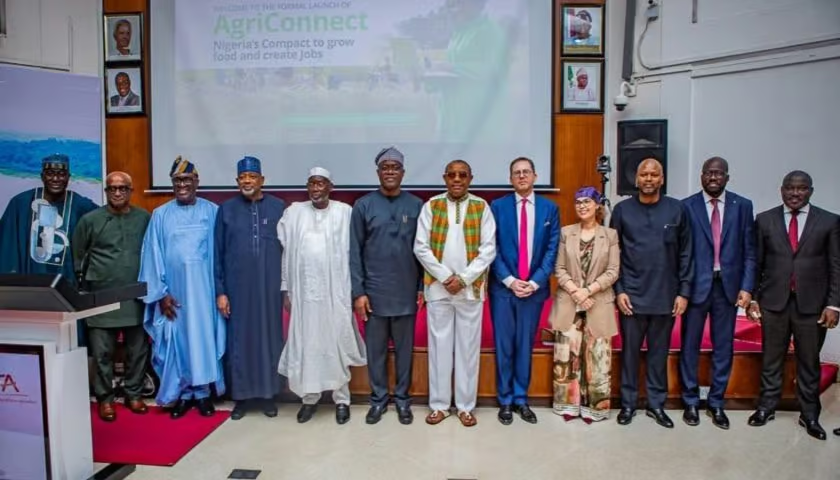
NIGERIA – Nigeria has launched the Nigeria AgriConnect Compact, a national framework that aims to increase agricultural productivity, strengthen food security, and accelerate investment across its food and agriculture value chains, as the program seeks to create 2.56 million jobs by 2031.
The initiative brings together the Federal Ministry of Agriculture and Food Security, the World Bank Group, the International Fund for Agricultural Development (IFAD), research institutions, private-sector participants and other development partners.
The Compact is part of the broader World Bank Group AgriConnect initiative, which aims to help smallholder farmers transition from subsistence production to commercially viable agriculture by improving access to markets, finance, technology and agricultural services.
At the country level, Nigeria’s programme is expected to strengthen connections between farmers, processors, financial institutions, businesses and markets.
According to IFAD, the Nigeria AgriConnect Compact targets improved food and nutrition security for nearly three million people alongside the creation of 2.56 million jobs.
The programme also aims to increase average yields of rice, maize and wheat by 30%, while targeting a 35% increase in cassava yields.
Livestock value chains, including cattle, small ruminants, pigs and poultry, are also expected to benefit through improved productivity and reproductive performance.
Priority areas include agricultural productivity, processing, market access, finance, infrastructure and greater private-sector participation.
Rice, maize and cassava are among the key value chains identified for increased productivity and value addition.
The approach aims to address constraints beyond primary production, including post-harvest management, access to reliable markets, and investment in agricultural businesses.
The initiative comes as Nigeria continues to seek ways to increase domestic food production while creating economic opportunities in rural areas.
The World Bank has identified agriculture and agribusiness as important channels for job creation, particularly when smallholder farmers are connected to processors, traders, input suppliers, financial services and other businesses across the food system.
The World Bank is also supporting Nigeria through the six-year AGROW project, approved in March 2026, which is expected to benefit up to one million smallholder farmers, strengthen agricultural value chains and mobilize an additional US$220 million in private agribusiness investment. The project forms part of Nigeria’s contribution to the wider AgriConnect agenda.
IFAD said its participation will focus on strengthening farmer organizations, improving post-harvest management and developing commercial linkages between producers and reliable markets.
AgriConnect is backed by a commitment from the World Bank Group to double its annual financing for agriculture and agribusiness to US$9 billion and mobilize an additional US$5 billion from partners.
The initiative is supported by a coalition of development and private-sector partners, including IFAD, the African Development Bank, the Inter-American Development Bank, Bayer and Google.
Sign up to HERE receive our email newsletters with the latest news and insights from Africa and around the world, and follow us on our WhatsApp channel for updates.