

Malawi faces soaring maize prices amid widening grain deficit
John Kapito, executive director of the Consumers Association of Malawi, warned that prices are likely to continue climbing as the country nears the lean season.
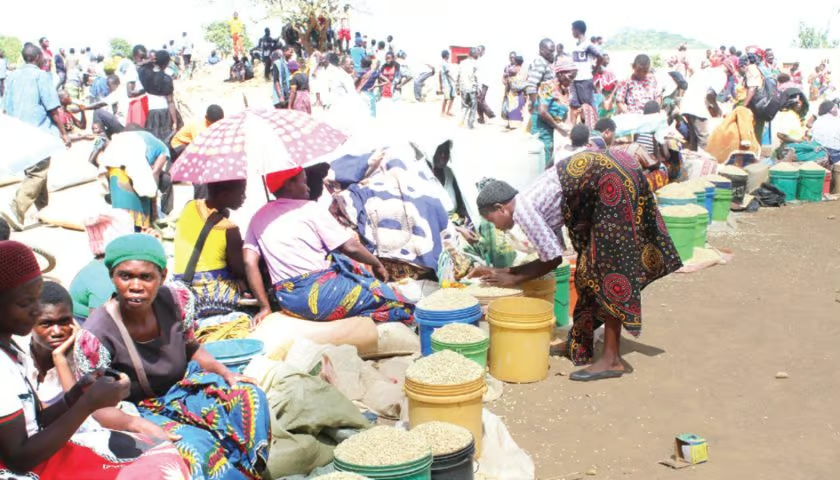
MALAWI – Maize prices in Malawi are rising sharply across several districts just three months after harvest, intensifying concerns over food security and prompting fresh calls for government intervention to stabilise supply and pricing.
Market checks conducted in Nsanje and Chikwawa show maize retailing at MWK 1,300 per kilogramme, translating to MWK 65,000 (US$38.20) per 50kg bag. In Blantyre, Balaka, Mulanje, Mangochi, and Lilongwe, prices range from MWK 59,000 to MWK 60,000 (US$34.65 to US$35.25) per bag, while vendors in Dedza, Karonga, Rumphi, and Nkhata Bay are selling the staple at MWK 48,000 to MWK 52,000 (US$28.20 to US$30.60).
This represents a notable increase from the post-harvest average in May, when a 50kg bag was priced at MWK 46,400 to MWK 46,650 (US$27.30 to US$27.50).
The continued price escalation coincides with a new World Food Programme (WFP) report projecting Malawi’s maize deficit for the 2024/25 season at 1.2 million metric tonnes (MT), more than double the previously estimated shortfall of 537,380 MT.
John Kapito, executive director of the Consumers Association of Malawi, warned that prices are likely to continue climbing as the country nears the lean season.
“The only way consumers can be protected is when the market has a huge supply of maize beyond demand. That’s when we can expect stable prices,” he said.
Grain Traders Association President Grace Mijiga Mhango urged the government to consider allowing private sector maize imports to improve availability, though she flagged foreign exchange shortages as a key constraint.
“People need to physically see the movement of maize. Once that happens, even those who are hoarding maize will start selling,” she said.
The Agricultural Development and Marketing Corporation (Admarc), Malawi’s state grain trader, is currently buying maize at MWK 1,050 per kilogramme (US$0.62), targeting to purchase 70,000MT this year.
However, CEO Daniel Makata reported that only 15,140MT has been procured so far. While asked if Admarc would raise its buying price to attract more traders, Makata said they were monitoring market trends before taking any action.
Agriculture Minister Sam Kawale noted the government is investing in local procurement strategies and promoting crop diversification to help address the deficit. He said efforts are also underway to strengthen food resilience through longer-term initiatives.
According to the 2025 Global Report on Food Crises by the International Food Policy Research Institute (IFPRI), at least 6.8 million Malawians, about 33% of the population, are struggling to meet their basic food needs, primarily due to rising costs and declining crop output.
Irrigation projects to bolster long-term food security
To reduce dependency on rain-fed farming and improve resilience to climate variability, Malawi is scaling up investment in irrigation infrastructure.
The Greenbelt Authority (GBA) this week handed over rehabilitation works worth MWK 30 billion (US$17.65 million) for the Lweya Irrigation Scheme in Nkhata Bay to two contractors, Pro Civils and Zipatso JV, and Shilpa Construction Company.
GBA CEO Eric Chidzungu said the 700-hectare project will support year-round maize and rice cultivation, aiming to improve national food supply by 2026.
Deputy Agriculture Minister Benedicto Chambo called for greater community ownership of the project and encouraged the transition to irrigation farming to boost yields and ensure food security.
Sign up to HERE receive our email newsletters with the latest news and insights from Africa and around the world, and follow us on our WhatsApp channel for updates.

