

Kenya launches US$4.6B irrigation plan to boost agriculture
The plan seeks to expand the area under irrigation by an additional one million acres over the next decade.
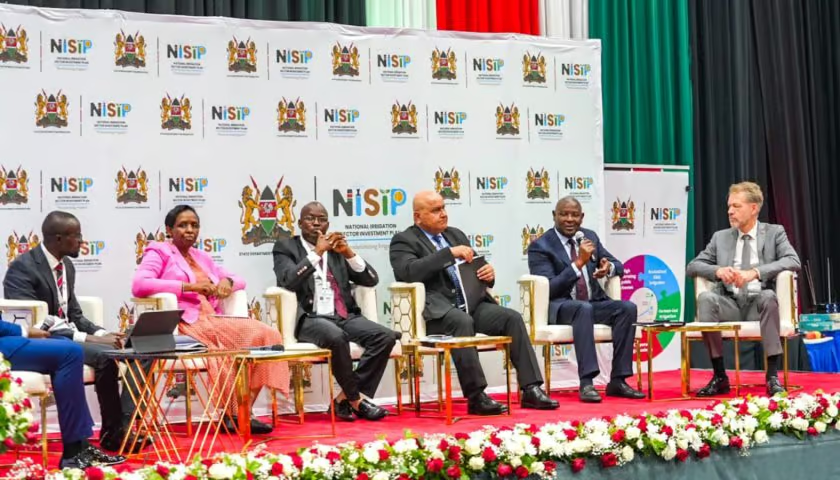
KENYA – The Kenyan government has launched the National Irrigation Sector Investment Plan (NISIP), a comprehensive 10-year strategy to transform the country’s agricultural landscape through enhanced irrigation practices.
The implementation of NISIP is expected to significantly enhance the production of key crops, including rice, maize, horticultural produce, and fodder. This, in turn, will enhance food security, reduce reliance on imports, and contribute to overall economic growth.
Unveiled on March 21, 2025, at the Kenyatta International Convention Centre (KICC) in Nairobi, the plan seeks to expand the area under irrigation by an additional one million acres over the next decade, with an estimated investment of approximately US$4.6 billion USD (KES598 billion).
Speaking at the launch event, Cabinet Secretary for Water, Sanitation, and Irrigation, Engineer Eric Mugaa, emphasized the critical role of agriculture in Kenya’s economy, noting that it contributes nearly 50% of the Gross Domestic Product (GDP) and is essential for food security and export earnings.
He highlighted that only 747,000 acres are currently under irrigation, representing just 21.3% of the country’s potential and a mere 5% of total arable land.
He further explained that NISIP is designed to accelerate irrigation expansion by integrating multiple funding sources and coordinating various sector players to ensure seamless implementation.
The plan identifies five major approaches to achieving its objectives. One of these is the Farmer-Led Irrigation Development (FLID) initiative, which aims to invest in grassroots farmers and promote self-initiated irrigation projects.
The second approach focuses on improving public irrigation schemes by enhancing governance, management, and modernization. In addition, the plan encourages the participation of the private sector in large-scale, commercially viable irrigation projects.
It also prioritizes revitalizing irrigation efforts in arid and semi-arid lands (ASALs) by providing water resources to boost agricultural activities in these drought-prone regions. Lastly, the plan seeks to maximize the benefits of community-based irrigation schemes to ensure they deliver optimal advantages for local populations.
Funding for the initiative is structured to ensure sustainability, with 61% of the required investment expected to come from the private sector, while the remaining 39% will be sourced from public funds, including government allocations and support from development partners.
The full implementation of NISIP is projected to generate annual revenues of approximately US$1.85 billion USD (KES240 billion), support over 700,000 heads of cattle, create more than five million direct and indirect jobs, and significantly reduce Kenya’s import deficit.
During the event, Principal Secretary in the State Department for Irrigation, Ephantus Kimotho, stressed the importance of mobilizing resources to expand irrigation.
He noted that increasing investment in the irrigation subsector would play a key role in making the country food self-sufficient and reducing dependency on food imports. He reiterated that private sector involvement is crucial in ensuring the plan’s success, particularly in financing large-scale irrigation projects.
A key component of the plan is the expansion of Kenya’s water storage capacity to support the increased irrigation coverage.
The government aims to increase water storage from the current 55 million cubic meters to 340 million cubic meters by 2027.
This will be achieved through the construction of major dams, including the Galana Dam in Tana River and Kilifi counties, High Grand Falls Dam in Tharaka Nithi and Kitui, Boston Dam in Bomet, Isiolo Dam, Radat Dam near Pekera in Baringo, and Lowaat Dam in Turkana.
These infrastructure developments will ensure a stable water supply for irrigation projects and contribute to long-term agricultural sustainability.
Sign up to HERE receive our email newsletters with the latest news and insights from Africa and around the world, and follow us on our WhatsApp channel for updates.