
GMOs and precision farming help keep South African food prices low
Higher crop yields from GMOs and precision farming have helped keep South Africa‘s food inflation at its lowest level in almost 16 years.

SOUTH AFRICA – Daily Maverick reports that genetically modified organisms (GMOs) and precision farming have helped keep South African food prices stable despite rising overall inflation, as higher crop yields continue to improve food supplies across the country.
While South Africa’s overall consumer inflation rose to 5% in June from 3% in February, food inflation fell to 1.4%, its lowest level in almost 16 years. Higher oil prices linked to tensions in the Middle East pushed overall inflation higher, but strong grain harvests reduced pressure on household food budgets.
The country’s 2025 to 2026 maize harvest is expected to reach a record 17.4 million tonnes, according to South Africa’s Crop Estimates Committee. Grain and oilseed production also reached 21.5 million tonnes, helping increase food supplies across the country.
“Grains were among the key products underpinning the moderation in consumer food price inflation,” said Wandile Sihlobo, Chief Economist at the Agricultural Business Chamber of South Africa.
Good rainfall from La Niña contributed to the strong harvest, but agricultural experts say years of investment in GMOs and precision farming also played an important role. Farmers have steadily increased production by using improved seed varieties, better soil management and precision farming tools such as GPS guided equipment and drones that apply farm inputs more accurately.
“With grain farming, it is all about moisture retention, especially in South Africa, as we are a semi arid country,” said Corné Louw, Head of Applied Economics at Grain SA.
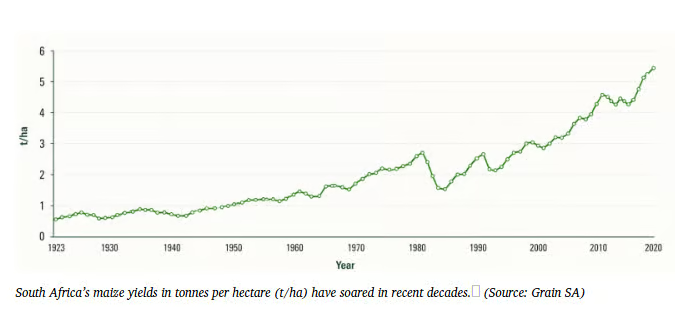
South Africa approved GMOs under the Genetically Modified Organisms Act in 1997. Since then, maize yields have increased from about 0.6 tonnes per hectare in the 1920s to around 6.4 tonnes per hectare today, according to Grain SA.
White maize, the country’s main staple food, has become cheaper, with maize meal prices almost 6% lower in June than a year earlier. Strong yellow maize production has also helped reduce feed costs for livestock producers, easing pressure on meat prices.
The lower food inflation rate has also supported the South African Reserve Bank’s decision to leave interest rates unchanged, as food accounts for about 18% of the country’s Consumer Price Index basket.
The work to improve crop performance continues across Africa and Asia. The International Crops Research Institute for the Semi Arid Tropics recently secured long term access to CRISPR Cas9 gene editing technology through a humanitarian licensing agreement with Corteva and The Broad Institute.
The agreement will support the development of improved varieties of sorghum, pearl millet, chickpea, pigeonpea and groundnut that can better withstand drought, heat, floods, pests and diseases.
“Corteva’s leadership in gene editing, combined with ICRISAT’s world leading breeding programs and our other long standing partnerships with national agricultural research systems, this new capability will accelerate the delivery of practical crop innovations that strengthen food security, improve livelihoods and build more resilient agricultural systems across Asia and Africa,” said ICRISAT Director General Dr Himanshu Pathak.
Sign up to HERE receive our email newsletters with the latest news and insights from Africa and around the world, and follow us on our WhatsApp channel for updates.