
Burundi launches US$100.5M credit facility to drive agricultural production
The financing is intended to address a major constraint facing Burundi’s agriculture sector: limited access to affordable capital.
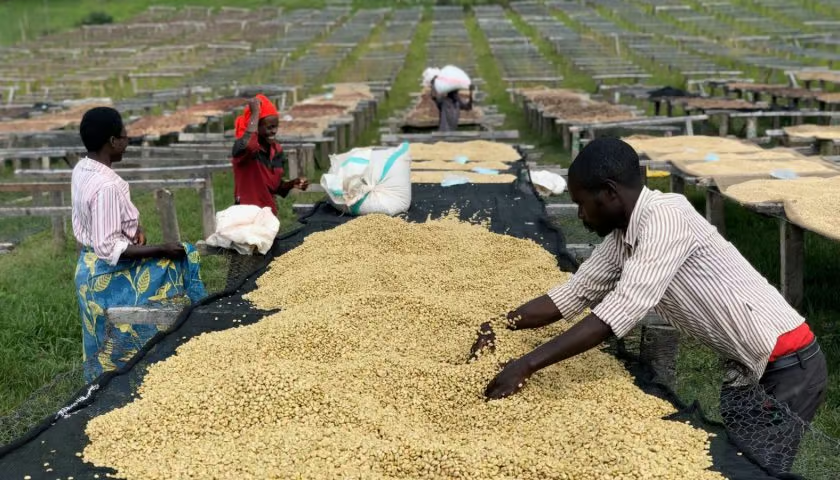
BURUNDI – The Burundian government has unveiled a 300 billion Burundian franc (US$100.5 million) low-interest credit facility designed to accelerate agricultural production, strengthen livestock operations, and expand domestic agro-processing capacity.
Administered through CRDB Bank Burundi, the new financing scheme offers eligible producers and agribusiness enterprises access to long-term loans at a highly competitive annual interest rate of 5%.
The initiative aims to address a critical financing gap in the country’s economic backbone.
Official figures indicate that agriculture accounts for roughly 39.6% of Burundi’s gross domestic product, supplies 95% of its domestic food requirements, and employs approximately 84% of the workforce.
Despite the sector’s outsized economic footprint, private sector lending to agriculture has historically remained constrained due to high interest rates, perceived weather risks, and limited long-term capital allocation from commercial financial institutions.
Under the facility framework, borrowers can secure capital earmarked for acquiring high-value productive assets.
These include modern agricultural machinery, livestock housing infrastructure, cold-chain transport units, irrigation systems, and commercial processing equipment.
By lowering the cost of capital, the program seeks to transition local operations from smallholder subsistence models toward commercially viable agribusiness enterprises.
Government authorities emphasized that the credit application mechanism will operate independently of state land allocation schemes.
While the Ministry of Environment, Agriculture, and Livestock oversees requests for state-owned land earmarked for agricultural expansion, CRDB Bank Burundi maintains total operational control over loan vetting and risk assessment to ensure commercial sustainability.
The targeted credit program aligns directly with Burundi’s long-term Vision 2040–2060 economic framework, which positions commercialized agriculture as a main engine for industrialization, export growth, and rural job creation.
State officials anticipate that expanding local processing through this affordable credit facility will gradually reduce the nation’s reliance on costly foreign food imports, stabilize domestic food supply chains, and build lasting climate resilience for farming communities across the country.
The facility comes as Burundi seeks to accelerate its Vision 2040-2060 development agenda, which identifies agriculture as a major driver of wealth creation and economic development.
The government also plans to raise agriculture’s share of public spending to 10%, compared with 9.4% in 2022.
Sign up to HERE receive our email newsletters with the latest news and insights from Africa and around the world, and follow us on our WhatsApp channel for updates.