

Africa’s storage capacity covers less than 30% of annual production: World Bank
Nearly 40% of perishable goods and 20% of other food products disappear from supply chains each year.
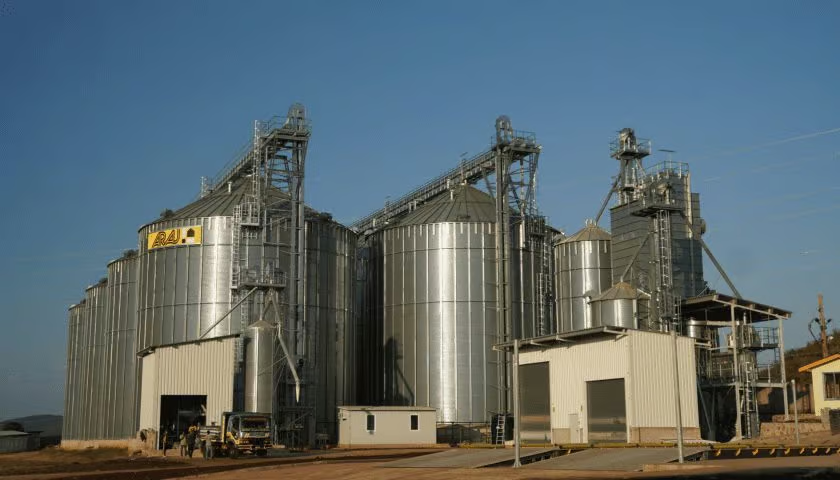
AFRICA – Sub-Saharan Africa’s food supply chains are under mounting pressure, with available storage capacity covering less than 30% of annual production.
This shortfall, highlighted in the World Bank’s Transport Connectivity for Food Security in Africa: Strengthening Supply Chains report released in May 2025, is contributing to severe post-harvest losses and deepening food insecurity across the region.
The report shows that nearly 40% of perishable goods and 20% of other food products disappear from supply chains each year, largely due to the absence of adequate warehousing and refrigeration facilities. Despite producing a large share of its food locally, the region struggles to preserve and distribute it effectively.
This lack of storage infrastructure adds to long-standing weaknesses in Africa’s supply chains. Already constrained by underdeveloped road, rail, and port systems, many operators function on a just-in-time basis with little capacity to absorb shocks from weather extremes, global market disruptions, or local conflicts.
According to the report, the warehousing market itself is expanding, but progress has yet to match the scale of the challenge.
Industry figures show that revenue generated by traditional, automated, refrigerated, and self-storage facilities in Africa and the Middle East reached US$ 83.1 billion in 2024, with projections of US$131.7 billion by 2030. This represents a compound annual growth rate of 8% between 2025 and 2030.
Cold storage warehouses are expected to drive much of this growth, reflecting rising demand for temperature-controlled facilities to handle fresh, frozen, and sensitive food products.
According to Knight Frank’s Africa Industrial Market Dashboard – H1 2025, occupancy rates for modern warehouses rose to 83% in the first half of this year, up from 75% a year earlier. Growth has been fueled by agribusiness expansion, a push toward food self-sufficiency, and the rapid rise of e-commerce.
Still, the gap between supply and demand remains stark. The World Bank caution that unless storage capacity expands significantly, post-harvest losses will continue to undermine Africa’s ability to feed its growing population. With the continent’s population projected to nearly double by 2050, the strain on supply chains is expected to intensify.
Sign up to HERE receive our email newsletters with the latest news and insights from Africa and around the world, and follow us on our WhatsApp channel for updates.