

Luke Lindberg to lead UN World Food Programme amid global hunger crisis
The organization estimates that as many as 266 million people worldwide face acute food insecurity, while WFP supports more than 100 million people across 83 countries.
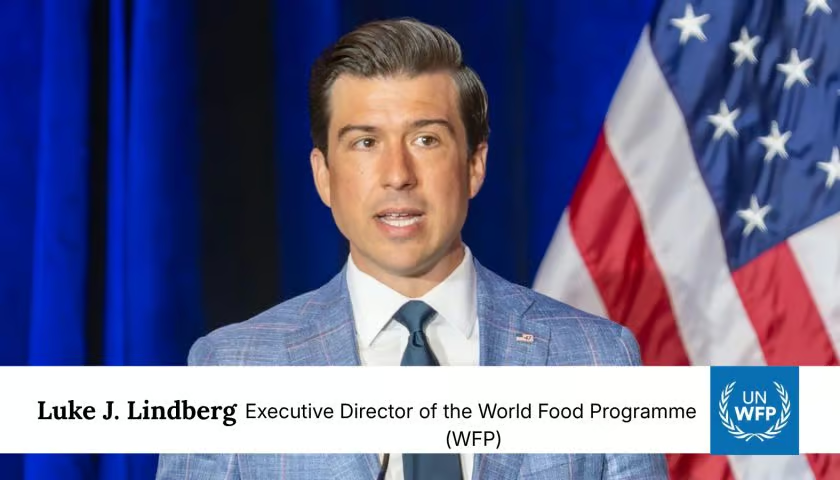
ITALY – United Nations Secretary-General António Guterres and Food and Agriculture Organization (FAO) Director-General Qu Dongyu have officially appointed American trade official Luke J. Lindberg as the next Executive Director of the World Food Programme (WFP).
The announcement, made in consultation with the WFP Executive Board, places the senior US Department of Agriculture (USDA) official at the helm of the world’s largest humanitarian organization during a pivotal moment of global food insecurity.
Lindberg succeeds Cindy McCain, who stepped down earlier this year due to health reasons, with Deputy Executive Director Carl Skau serving as acting chief during the transition.
Most recently, Lindberg served as Under Secretary of Agriculture for Trade and Foreign Agricultural Affairs, bringing extensive experience in international trade, supply chain strategy, and agricultural policy to the Rome-based UN agency.
His background includes leading global health operations across multiple countries and managing trade portfolios at the Export-Import Bank of the United States.
The appointment continues a long-standing tradition of American leadership at the WFP, unbroken since 1992.
As the organization’s primary donor country, the United States plays a vital role in funding its frontline emergency operations.
Lindberg assumes the leadership role as the humanitarian sector faces unprecedented financial strain.
WFP assessments estimate that over 266 million people globally are experiencing acute hunger, yet widening budget deficits mean the agency currently expects to assist around 110 million people this year.
During his five-year mandate, Lindberg will expand donor partnerships, modernize logistics chains, and direct relief efforts across active conflict zones, climate extremes, and displacement hotspots.
Facing strict budget constraints and rising operational costs, the incoming chief faces the challenge of maximizing food distribution efficiency while encouraging increased voluntary contributions from global governments and private partners.
Humanitarian analysts note that his dual expertise in agricultural export systems and public-sector management could help reshape the agency’s relief operations and procurement networks worldwide.
His appointment comes as global food security challenges remain substantial. WFP and other UN agencies reported in July that about 645 million people experienced hunger in 2025, while Africa accounted for approximately 309 million people facing hunger. The agencies also highlighted conflict, extreme weather, economic pressures, and reduced humanitarian funding as continuing challenges to progress toward Zero Hunger.
Sign up to HERE receive our email newsletters with the latest news and insights from Africa and around the world, and follow us on our WhatsApp channel for updates.