

India lifts restrictions on exports of wheat, wheat flour products
Lifting these restrictions marks a shift from a policy focused primarily on domestic supply protection to greater participation in international markets.
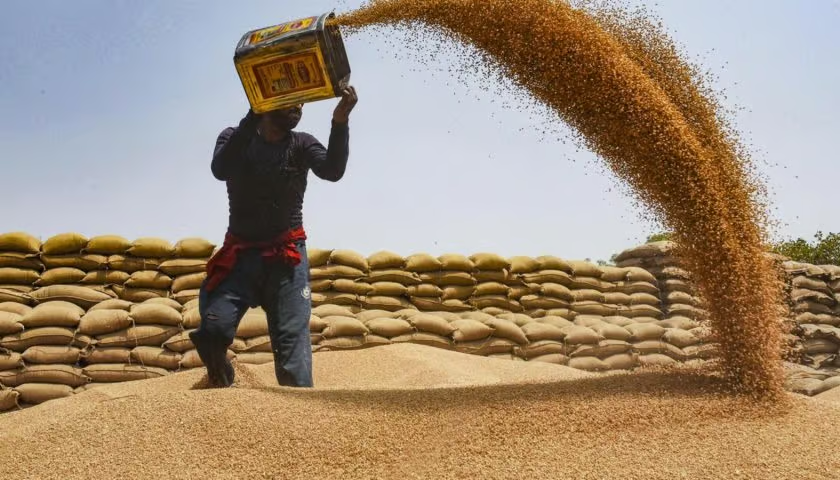
INDIA – The Government of India has formally removed export restrictions on wheat and wheat-based flour products, transitioning them from the “Prohibited” category to “Free” status with immediate effect.
Issued by the Directorate General of Foreign Trade (DGFT), the notification ends a four-year export ban originally enacted in May 2022 to control domestic food inflation and stabilize local grain reserves during global supply shocks caused by the Russia-Ukraine war.
The updated policy framework applies broadly to all major wheat varieties, including durum wheat, as well as processed derivatives such as wholemeal atta, maida (refined flour), and semolina.
The government’s decision to reopen overseas markets follows a record-setting harvest and substantial recovery in national grain stockpiles.
Official figures from the Ministry of Agriculture estimate India’s wheat production for the 2025-2026 crop year at a historic 120.65 million tonnes, up from 117.94 million tonnes in the preceding cycle.
India is set for a fourth consecutive record wheat harvest this summer, at 120 million tonnes for the 2026-27 marketing season, driven by favourable weather that supported record planting and yield prospects in major wheat-growing states, according to the US Department of Agriculture’s (USDA) Foreign Agricultural Service (FAS).
With state-managed buffer stocks held by the Food Corporation of India (FCI) at comfortably high levels, officials noted that domestic supply is secure enough to meet local demand while allowing excess volumes to enter international trade channels.
Union Food Secretary Sanjeev Chopra emphasized that the primary motivation behind lifting the restrictions is supporting domestic farmer incomes.
Local mandi (wholesale market) prices for wheat had recently flattened due to bumper arrivals, creating concerns about potential distress sales.
By reopening export channels, policymakers aim to stimulate competitive buying, lift wholesale realization rates, and encourage healthy sowing numbers for the upcoming rabi winter-crop planting season.
Furthermore, the move shifts trade away from a rigid quota and licensing regime toward open-market mechanisms, giving commercial millers and exporters greater operational agility.
The policy shift is expected to help Indian agricultural exporters reclaim market share across traditional buyer hubs, particularly in neighboring and regional markets throughout South Asia, Southeast Asia, and the Middle East, including Bangladesh, Indonesia, the Philippines, Vietnam, Sri Lanka, and the UAE.
While trade experts caution that high domestic minimum support prices may pose near-term price competitiveness challenges against major global suppliers like Russia and Australia, industry groups have welcomed the deregulation as a essential step toward stabilizing long-term agricultural growth.
Sign up to HERE receive our email newsletters with the latest news and insights from Africa and around the world, and follow us on our WhatsApp channel for updates.