

India moves to end pulse imports with major farm push
Government plan aims to secure full local supply of key protein foods within the decade.
INDIA – India has set out a clear plan to stop relying on imported pulses, backed by new policy, science, and farmer support.
For years, the country has stood as the top producer and consumer of pulses while still buying large volumes from abroad. That gap may soon close. A new national programme launched on October 11, 2025, seeks to raise local output and cut imports.
Prime Minister Narendra Modi introduced the Mission for Aatmanirbharta in Pulses, a six-year plan worth Rs 11,440 crore, about US$1.38 billion. The programme targets production of 350 lakh tonnes by 2030 to 2031 and aims to expand farming land under pulses to 310 lakh hectares.
The plan also promises full government purchase at minimum support price for tur, urad, and masoor for four years. Officials expect close to two crore farmers to benefit through seed support, better market access, and stable prices.
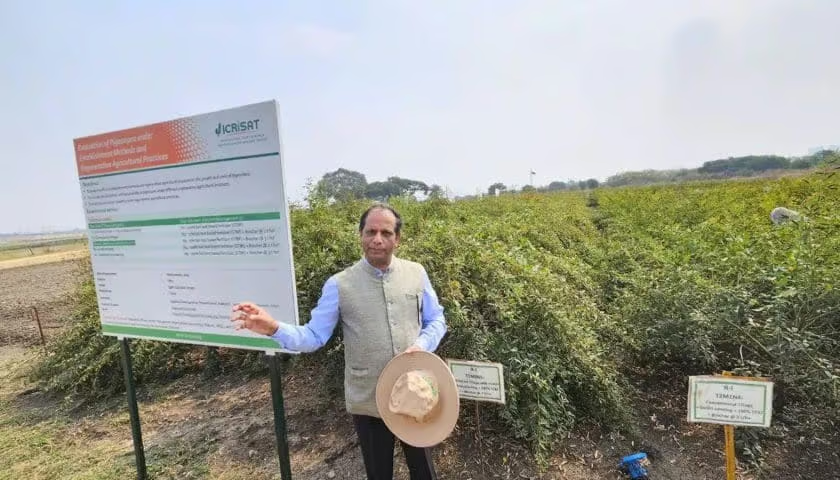
Science plays a central role in this push. At the International Crops Research Institute for the Semi-Arid Tropics in Hyderabad, researchers have developed new seed types that mature faster and produce higher yields.
“We produce around 25 million tonnes of pulses, but we still import five to six million tonnes every year, depending on the season,” said Dr Himanshu Pathak, Director General of ICRISAT.
He noted that low yields remain the main issue. Current output stands at about 800 to 900 kilograms per hectare, but new varieties can raise this to 1.4 to 1.5 tonnes.
“That productivity has to go up to 1.4 or 1.5 tonnes per hectare, and that is entirely possible with the varieties we now have,” he said.
One new pigeon pea type matures in 120 to 125 days instead of up to 180 days and can yield up to 2.5 tonnes per hectare. It also handles high heat and suits machine harvesting.
The programme also looks at changing crop patterns. Experts say some low-yield rice areas could shift to pulses, saving water and improving soil health. Pulses use less water and add nitrogen to the soil.
“The amount of water used to grow one rice crop, you can grow five pigeon pea crops with the same water,” Dr Pathak explained.
India now imports about 15 to 20 percent of its pulse needs. If this plan works, the country could meet its own demand and even influence global markets.
Recent trade signals from the United States, including a brief mention of tariff cuts on certain pulses, added urgency to the issue. India’s response shows it plans to rely less on external supply and focus on local strength instead.
Sign up to HERE receive our email newsletters with the latest news and insights from Africa and around the world, and follow us on our WhatsApp channel for updates.

