

Kenyan millers defend neglecting local wheat farmers amid US$386M surplus allegations
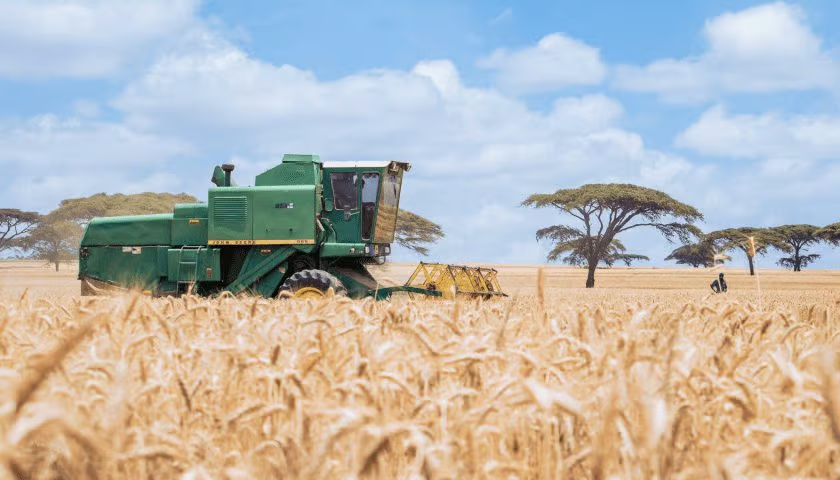
KENYA – Cereal millers in Kenya have dismissed allegations that they are sidelining local wheat producers in favor of imports, following accusations that farmers in Narok County are sitting on unsold wheat worth Sh50 billion, approximately US$386 million.
The Cereal Millers Association (CMA) has refuted these claims, stating that its members have consistently purchased all available local wheat over the past two decades.
According to Paloma Fernandes, CMA CEO, Kenya produces only a fraction of its national wheat demand, with local farmers supplying approximately seven per cent of the 24 million bags consumed annually.
Fernandes argued that CMA members, who account for over 95 per cent of the country’s wheat milling, have remained committed to supporting local farmers, she said.
In the 2023-2024 season, CMA millers procured the entire 1,458,881 bags of wheat produced locally. For the 2024-2025 season, as of February 10, 2025, 1,246,000 bags had already been purchased.
Fernandes emphasized that the claim of unsold wheat worth KES50 billion in Narok alone is “factually inaccurate.” She explained that wheat farming in Kenya extends beyond Narok to regions such as Nakuru, Laikipia, Uasin Gishu, and Timau.
“The total national value of wheat produced across all these regions, based on the 1.7 million bags expected this season at KES 5,300 (US$41) per bag, stands at approximately KES9 billion, not KES 50 billion as alleged,” Fernandes said.
She added that KES 50 billion worth of unsold wheat would equate to 10 million bags, which is approximately six years of local production.
Structural Challenges and High Costs
Despite their commitment to local wheat, millers cited structural challenges hindering the growth of the industry.
High production costs, low yields per acre, and limited mechanization have made Kenyan wheat less competitive compared to imports. Farmers face steep input costs, including fertilizer and fuel, which drive up the price of local wheat.
CMA members operate under a duty remission scheme, which requires them to prioritize local wheat purchases at a premium price before seeking import approvals.
For the 2024-2025 season, millers are purchasing local wheat at KES 5,300 (US$41) per 90kg bag, significantly higher than the global import parity price of between KES 3,500 (US$27) to KES 3,700 (US$28.6) This represents a difference of nearly KES1,500 (US$11.6) per bag.
Import delays threaten market stability
Meanwhile, as a net wheat importer, wheat millers have decried several challenges in the import market, particularly severe delays in government import approvals.
These bottlenecks have led to skyrocketing demurrage costs at the port, threatening the delicate balance between local and imported wheat.
Fernandes warned that if these delays persist, Kenya risks market instability, potential wheat shortages, and higher consumer prices.
“While millers remain committed to purchasing locally grown wheat and protecting local farmers, these structural challenges and bureaucratic delays continue to hinder the industry’s growth,” Fernandes said.
She reaffirmed CMA’s dedication to supporting local wheat farmers and strengthening Kenya’s wheat value chain, urging the government to address the bottlenecks to ensure market stability.
Sign up to HERE receive our email newsletters with the latest news and insights from Africa and around the world, and follow us on our WhatsApp channel for updates.

