

BAKING TECHNOLOGY: Staling
Staling remains one of the most persistent and complex shelf-life issues in commercial baking.
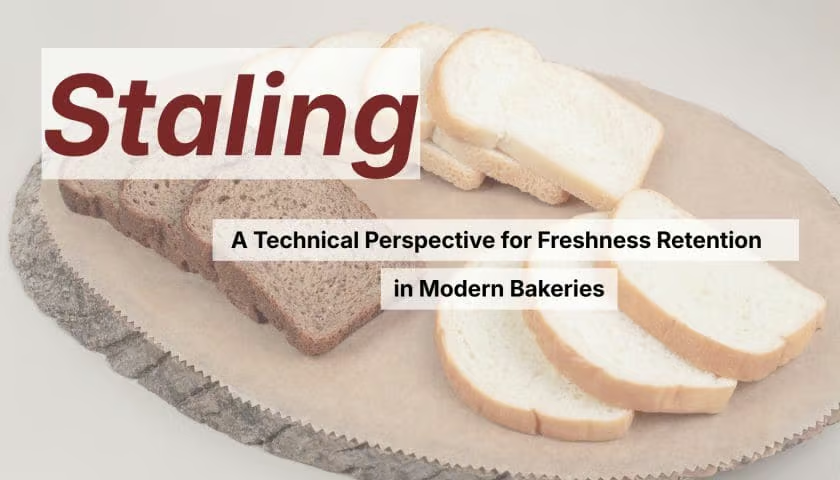
Staling: A Technical Perspective for Freshness Retention in Modern Bakeries
Fresh bread quality is not accidental; it is engineered through precise formulation, controlled processing, and scientific understanding of cereal chemistry.
In industrial baking environments, keeping crumb softness, elasticity, and overall sensory appeal over the full shelf life is a technical challenge with direct implications for product consistency, costs, and brand reputation.
Within hours after baking, bread undergoes structural and molecular transformations that significantly influence texture and consumer acceptability.
This change, known as staling, remains one of the most persistent and complex shelf-life issues in commercial baking.
The Molecular Basis of Staling: Starch Retrogradation
Bread staling results from starch retrogradation, a molecular reorganization that takes place after the loaf cools. During baking, starch granules within the dough absorb water and gelatinize once they reach approximately 60-65°C, shifting from an ordered crystalline to a disordered, amorphous state. This gelatinized starch, together with a well-developed gluten network, gives fresh bread its soft texture. After cooling, however, the starch components, particularly amylose and amylopectin, begin to reassociate and recrystallize, driving progressive crumb firming. This recrystallization traps water within crystalline regions and shifts water distribution within the bread matrix, changing the texture over time.
Amylose retrogradation occurs relatively quickly during cooling and contributes immediately to crumb firmness. Amylopectin retrogradation, in contrast, is a slower process that governs long-term staling and firming over days of storage. The recrystallization of amylopectin effectively pulls water out of the gluten matrix and redistributes it into more ordered starch structures, reducing crumb resilience and flexibility.
Water migration from crumb to crust further compounds textural deterioration, particularly in unwrapped products, as moisture gradients form and accelerate firming. Bread staling is thus not merely moisture loss; it is the molecular reorganization of starch polymers and associated water redistribution, a distinction that is essential for industrial shelf-life control strategies.
Quantifying Staling
Staling is quantifiable, and research has developed models to predict firmness increases over time. For example, studies on whole wheat bread have established equations relating firmness to the concentration of formulation components such as bran, allowing bakers to estimate staling rates and optimize additive use and process parameters accordingly. In these models, the staling rate constant (K) increased with higher bran content, demonstrating that compositional variables significantly influence firming kinetics during storage.
Kinetic modelling often employs approaches such as the Avrami equation to describe amylopectin recrystallization and correlate it with measurable texture changes, providing analytical leverage in product development and quality control.
Storage Conditions: Temperature effects on retrogradation
Storage temperature has a decisive effect on the rate of starch retrogradation and thus on shelf life. A widespread misconception, particularly in consumer contexts, is that refrigeration preserves bread freshness. In industrial settings, refrigeration (0–10°C) actually accelerates amylopectin recrystallization and crumb firming, increasing staling rates compared with room temperature storage. Freezing, on the other hand, significantly slows molecular mobility, delaying retrogradation and extending shelf life, but requires careful control of thawing conditions to avoid moisture migration artifacts. Reheating can temporarily soften the crumb by disrupting crystalline structures but does not restore the original molecular organization established at bake.
Understanding these temperature-dependent effects is critical for distribution planning, cold chain management, and retail display strategies.
Industrial Strategies to Delay Staling
Commercial bakeries deploy multi-faceted approaches to mitigate staling and extend product usability. These include:
- Emulsifiers such as diacetyl tartaric acid esters of mono- and diglycerides (DATEM) and sodium stearoyl lactylate (SSL), which strengthen dough structure and interact with starch to inhibit retrogradation.
- Enzyme systems, particularly maltogenic and other specialized α-amylases, which modify starch breakdown and reduce amylopectin recrystallization and firming. Studies show that anti-staling enzymes can significantly alter spatial staling kinetics and improve softness retention over time.
- Hydration optimization to balance gelatinization and water mobility without compromising dough handling or crumb structure.
- Controlled cooling to ensure uniform starch gelatinization and reduce moisture gradients that can predispose crumb to uneven firming.
- Water activity management through packaging technologies that regulate moisture exchange between the product and the environment, stabilizing textural properties without increasing microbial risk.
Beyond processing aids, alternative formulations such as sourdough systems with specific lactic acid bacterial strains have shown promise in slowing staling rates by inhibiting amylopectin recrystallization and modifying gluten network properties, thereby offering potential for clean-label freshness enhancement.
Shelf Life, Quality, and Profitability
In industrial bakery operations, effective staling control is closely tied to key performance indicators such as product consistency, return rates, customer satisfaction, operational costs, and brand reputation. A product that retains desirable sensory attributes for longer on store shelves reduces waste, improves sales velocity, and enhances profitability—particularly in fast-moving consumer goods (FMCG) markets where retail partners demand predictable quality and shelf performance.
Understanding the science of staling enables bakers and food technologists to move beyond traditional empirical methods to predictive quality engineering. It allows production teams to optimize formulations, refine process controls, select appropriate functional ingredients, and design storage and distribution systems that align with expected shelf life goals.
Bread staling follows well-characterized scientific principles. When these principles are correctly applied through formulation design, processing engineering, and storage logistics, freshness becomes a managed variable rather than a random outcome. Investing in technical knowledge and analytical tools for staling control is crucial for modern commercial bakeries aiming to deliver high-quality products with reliable and extended shelf life.
By William Gatama, Baking technologist.
This feature appeared in ISSUE 18 of MILLING MIDDLE EAST & AFRICA MAGAZINE. You can read this and the entire magazine HERE.

