

Kenyan farmers embrace barley as wheat economics tighten
Kenya has positioned itself as East Africa‘s leading supplier of raw barley, with exports estimated at 39,997 tonnes in 2025.
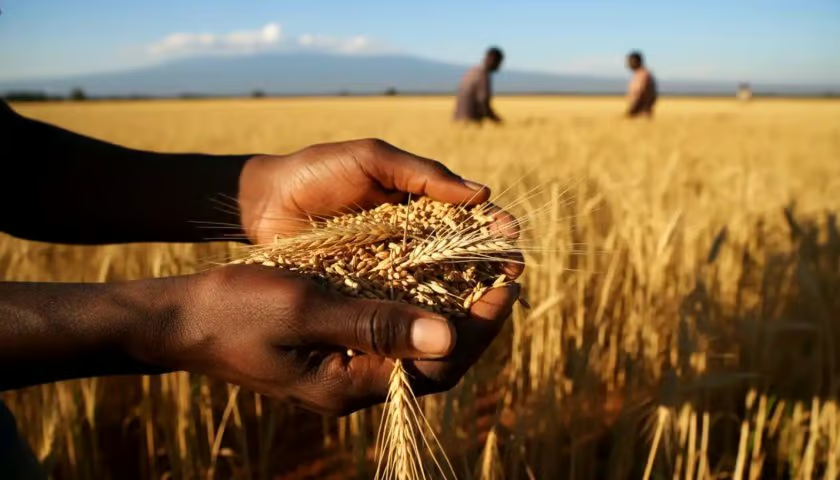
KENYA – Kenyan farmers are increasingly turning to barley as an alternative to wheat, driven by high production costs, rigid pricing structures, and import competition in the wheat market, according to a report from the US Department of Agriculture’s Foreign Agricultural Service (USDA FAS).
The report says barley is gaining appeal because it can be cultivated under similar soil and climatic conditions across key agricultural regions, including Narok, Nakuru and Meru.
The shift comes as rising regional demand strengthens barley prices, creating new opportunities for Kenyan producers.
Historically supported by domestic contract farming, the crop is becoming increasingly attractive as export markets offer competitive returns.
However, stronger regional demand has also reduced supplies available to some domestic buyers, highlighting the growing competition for locally produced grain.
Barley production in Kenya is heavily concentrated in high-altitude regions with cool climates, fertile volcanic soil, and reliable rainfall.
After a severe weather-induced downturn in 2023, when yields bottomed out at 2.47 tonnes/hectare, Kenya’s barley sector has recovered strongly over the following years.
Output surged 64.6% in 2024 and grew another 19.8% in 2025, reaching a record 64,800 tonnes.
Despite this growth, wheat remains the dominant grain crop, with the FAS forecasting 280,000 tonnes of production for the 2026/27 marketing year, but barley has become an attractive alternative.
Barley marketing in Kenya represents one of the country’s most vertically integrated agribusiness value chains.
Kenya’s barley value chain is closely linked to the brewing industry, particularly through contract farming arrangements that set production and quality requirements.
Grain intended for malting must meet stringent specifications, and contracted buyers and their agents inspect it at collection depots and silos.
Automated testing equipment helps assess deliveries and determine whether grain meets the required standards.
“Since the product must satisfy strict brewing standards, the contracting firm maintains rigorous quality control at the post-harvest handling stages,” the FAS said. “At centralized collection depots and silos managed by agents, inspectors deploy automated testing equipment to instantly evaluate deliveries.”
The market also distinguishes between premium malting-grade barley and lower-quality grain sold for animal feed.
While feed-grade barley provides an alternative outlet for farmers whose harvests fail to meet malting specifications, its prices remain volatile and depend partly on local supply conditions and the availability of competing feed ingredients, including maize.
Kenya has established itself as a leading supplier of raw barley in East Africa. Exports reached an estimated 39,997 tonnes in 2025, with Uganda and Tanzania among the principal destinations within the East African Community.
However, the sector still faces significant challenges spanning climate variability, volatile input prices, and land tenure.
Erratic rainfall and frequent droughts disrupt production and compromise grain quality, making it difficult for farmers to meet strict malting standards.
The FAS noted that weak land tenure systems and short-term leases also discourage long-term investments in soil health and infrastructure.
Despite these hurdles, barley remains more competitive than wheat because of higher prices and better post-harvest logistics.
Sign up to HERE receive our email newsletters with the latest news and insights from Africa and around the world, and follow us on our WhatsApp channel for updates.