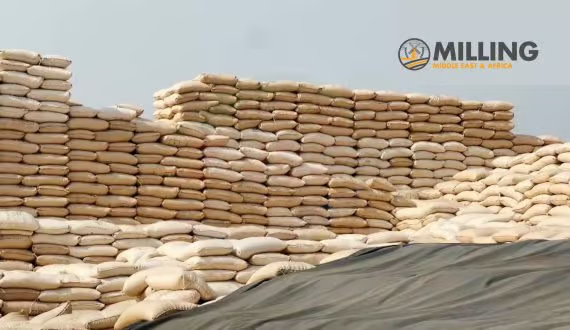

India expands decentralized grain infrastructure to strengthen food security
The initiative, implemented primarily through Primary Agricultural Credit Societies (PACS), aims to reduce post-harvest losses, lower transportation costs, improve farmers’ access to storage, and strengthen the country’s food-security system.
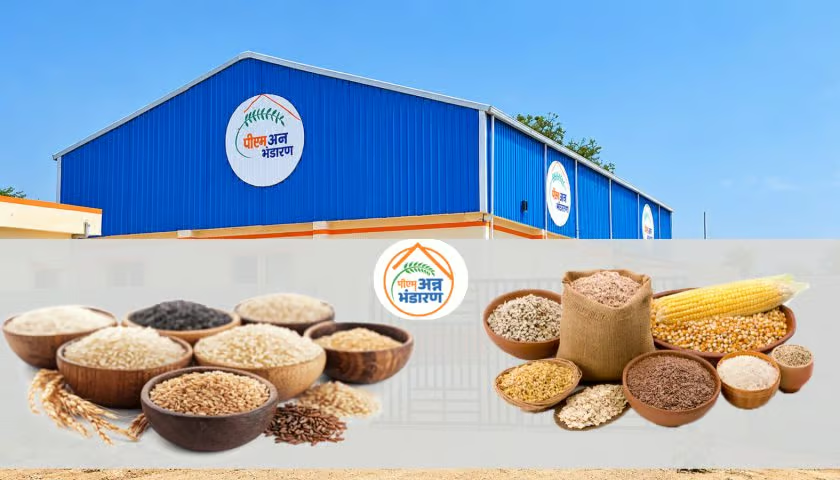
INDIA – India has significantly accelerated the expansion of its nationwide decentralized grain storage infrastructure, establishing more than 180,000 tonnes of local storage capacity through Primary Agricultural Credit Societies (PACS) across the country.
The ambitious government-led drive, rolled out through the National Cooperative Development Corporation (NCDC), is transforming village-level credit societies into multi-purpose agricultural hubs equipped with modern warehouses, processing units, and custom hiring centres.
The plan, launched in 2023 and supported by government financing initiatives, aims to improve storage, processing, procurement, and distribution systems.
The Ministry of Cooperation confirmed that 1,012 cooperative societies have been identified for development, with 313 PACS already completing godown construction as part of the broader World’s Largest Grain Storage Plan in the Cooperative Sector.
By shifting from traditional, centralized storage managed far from farmlands by the Food Corporation of India (FCI) to hyper-local infrastructure, the project aims to minimize supply chain losses, cut heavy inter-state transportation expenses, and streamline procurement directly at the farm gate.
The policy shift comes at a critical juncture, as India’s total annual foodgrain production reaches a record high of nearly 376.5 million tonnes.
For small and marginal farmers, the availability of village-level storage provides a vital safeguard against distress sales.
Rather than dumping harvested crops into oversupplied spot markets during peak season, farmers can now safely store their produce locally, receive immediate liquidity advances, and sell at more favorable prices later in the marketing cycle.
To ensure long-term financial viability, the initiative integrates multiple government schemes, such as the Agriculture Infrastructure Fund (AIF), Agricultural Marketing Infrastructure (AMI), Sub-Mission on Agricultural Mechanization (SMAM) and the Pradhan Mantri Formalization of Micro Food Processing Enterprises Scheme (PMFME), providing cooperatives with enhanced capital subsidies and interest subventions that lower effective borrowing costs.
Additionally, the Food Corporation of India (FCI) offers assured hiring contracts for eligible new godowns, providing rural cooperatives with a steady rental revenue stream while expanding national reserve capacity.
The grain storage plan has progressed through a phased implementation strategy, beginning with pilot projects and moving toward scaled expansion, the government said.
Under the pilot phase, warehouse construction was completed in 11 PACS across 11 states, creating 9,750 tonnes of storage capacity.

A recent example comes from Maharashtra, where Nerpingalai PACS in Amravati has constructed a 3,000-tonne warehouse under the programme. Around 300 farmers already use the facility to store soybean, while the cooperative has provided advances against stored produce, showing how local storage can also improve farmers’ access to liquidity.
The expansion comes as India continues to manage large grain procurement and distribution requirements. Recent government data showed that the country has substantial rice reserves, even as the 2026 kharif paddy area declined by 4% because of deficient monsoon rainfall.
Agricultural experts and industry leaders have praised the decentralized framework as a transformative model for regional food distribution and disaster resilience.
By shortening the physical distance between harvesting, procurement, and local Fair Price Shops, India is creating a more responsive supply network that protects national buffer stocks while empowering rural farming communities.
India remains the world’s second-largest wheat producer and its top rice producer, and the USDA’s Foreign Agricultural Service is forecasting a fourth consecutive record wheat harvest of 120 million tonnes for marketing year 2026/27.
Sign up to HERE receive our email newsletters with the latest news and insights from Africa and around the world, and follow us on our WhatsApp channel for updates.