

Kenya steps up national rice survey as government seeks higher local production
The survey aims to give the government fresh data to guide investments, improve irrigation, and increase local rice production.
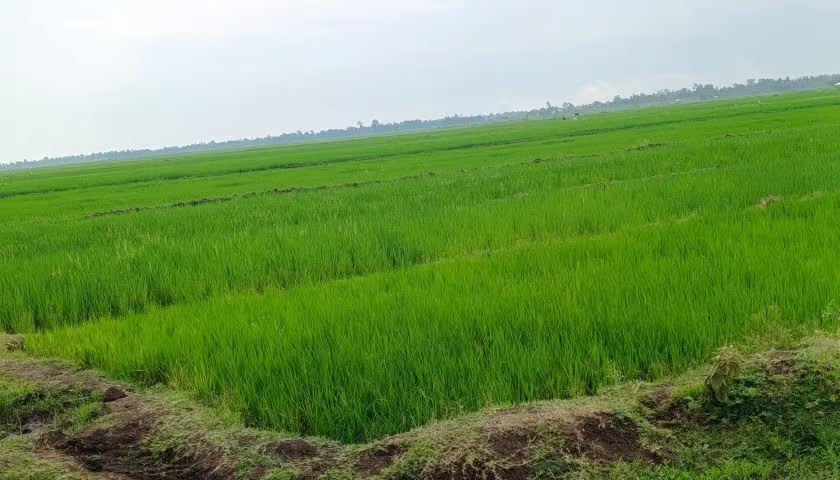
KENYA – Kenya’s State Department for Irrigation has stepped up the National Rice Baseline Survey across the country’s main rice growing regions as the government seeks better data to increase local production and cut rice imports.
The nationwide survey will collect information that will help shape policy, guide public investment, and support programmes that increase rice output. Rice remains Kenya’s second most consumed cereal after maize, making local production an important part of the country’s food security plans.
Survey teams are collecting data on the size of land under rice cultivation in public and community irrigation schemes, current production levels, the condition of irrigation systems, and the main challenges affecting farmers.
The exercise will also examine the use of certified seeds, fertilisers, mechanisation, irrigation systems, extension services, and other farm inputs. Officials will also review post harvest handling, storage, milling, value addition, and marketing to identify areas that need improvement and help reduce post harvest losses.
The State Department for Irrigation said the findings will support targeted programmes that improve irrigation efficiency, increase access to quality farm inputs, strengthen farmer skills, and expand rice production in both existing and new irrigation schemes.
The survey supports the government’s wider plan to increase land under irrigation through better water management. It also complements ongoing work to rehabilitate irrigation infrastructure, expand rice schemes, and introduce improved production methods that can raise yields.
Officials expect the baseline data to provide a clear guide for increasing local rice production, improving farmer incomes, creating jobs across the rice value chain, and reducing Kenya’s dependence on imported rice.
The survey comes as Kenya’s rice sector faces fresh debate over imports. Earlier this month, the High Court ordered several government agencies to release records linked to the duty free importation of 490,000 tonnes of rice after certifying a petition filed by the Ahero Rice Farmers Association as urgent.
The court directed the National Treasury, Ministry of Agriculture, Agriculture and Food Authority, Kenya Revenue Authority, Attorney General, and Kenya National Trading Corporation to submit documents related to the import programme within seven days.
The dispute centres on Gazette Notice No. 10061, issued on July 6, which approved duty free imports of Grade 1 milled white rice until November 30, 2026. Farmers argue that the programme could lower farm gate prices and affect investment in irrigation, seed, fertiliser, and milling in Ahero, Mwea, Bunyala, and West Kano. The case remains before the court.
Sign up to HERE receive our email newsletters with the latest news and insights from Africa and around the world, and follow us on our WhatsApp channel for updates.