

Syria advances seed system recovery through joint FAO-ICARDA collaboration
The programme is designed to restore the full seed value chain, including research, early-generation seed production, multiplication, certification and farmer adoption.
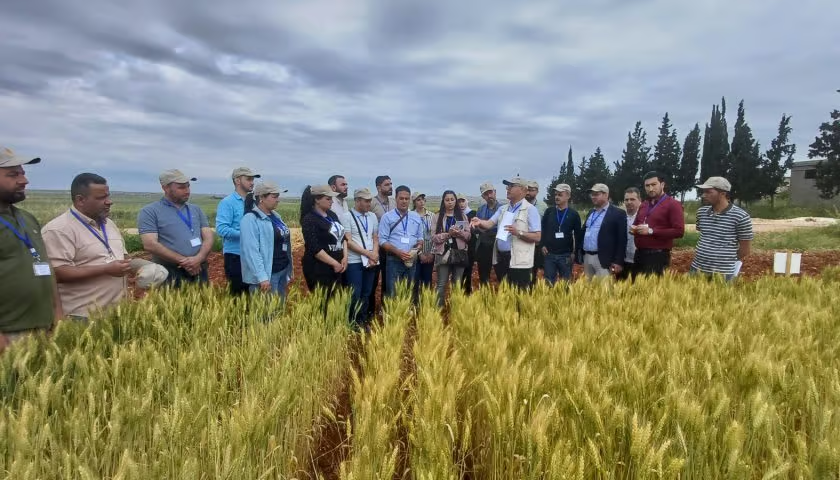
SYRIA – A collaborative initiative led by the International Center for Agricultural Research in the Dry Areas (ICARDA) and the Food and Agriculture Organization of the United Nations (FAO), alongside local partners, is revitalizing Syria’s agricultural foundation through a structured seed system restoration program.
Funded by the UK Foreign, Commonwealth and Development Office (FCDO), the effort bridges the gap between scientific research and field production to secure food supplies and rebuild rural livelihoods battered by years of conflict and climate stress.
The programme builds on a key step in late 2025, when 1,625 kilograms of early-generation seed of Syrian-released cereal varieties, including high-yielding, drought-tolerant varieties of durum wheat, soft wheat, barley, and legumes, was procured, ensuring high-quality genetic material was available to launch a sustainable, in-country multiplication system.
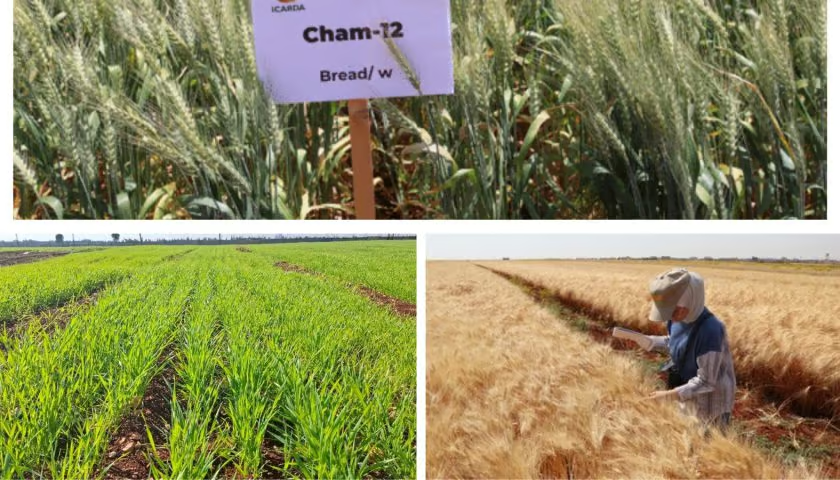
These pure genetic materials serve as the baseline to reignite in-country seed production.
Seven key multiplication plots were established at ICARDA, the General Commission for Scientific Agricultural Research (GCSAR), and the General Organization for Seed Multiplication (GOSM) facilities across locations including Aleppo, Qarhata, and Al-Ghab.
These research stations function as the core pipeline, scaling small quantities of breeder seed into foundation and registered seed stocks.
To move seeds from research centers into local hands, the initiative established four regional Seed Growers Associations (SGAs) across Aleppo, Homs, and Hama.
Dozens of local farmers covering nearly 200 hectares are actively multiplying certified wheat and legume varieties directly tailored to Syrian growing conditions.
To support production, the FAO and ICARDA have supplied critical agricultural inputs, including fertilizers and operational resources, while organizing technical training for researchers and local growers on seed purity, pest control, and field management.
By establishing a self-sustaining cycle that scales seed production from initial kilograms to hundreds of tons of certified grain over the next few years, the project aims to reduce dependence on external seed imports and strengthen national agricultural autonomy.
Rebuilding this essential pipeline equips Syrian farmers with resilient, disease-free crops needed to withstand water scarcity, adapt to shifting climates, and achieve long-term food security.
According to ICARDA, hundreds of tonnes of certified seed are expected to reach Syrian farming communities by 2027 as multiplication cycles progress.
The initiative also aligns with FAO’s broader three-year Emergency and Recovery Plan of Action for Syria, which prioritizes rehabilitating sustainable farming systems and ensuring farmers have access to high-quality seeds.
Sign up to HERE receive our email newsletters with the latest news and insights from Africa and around the world, and follow us on our WhatsApp channel for updates.