
Mauritania launches national wheat seed multiplication initiative under AATB program
The initiative also extends support to improving practices across the wheat value chain, including harvest and post-harvest management.
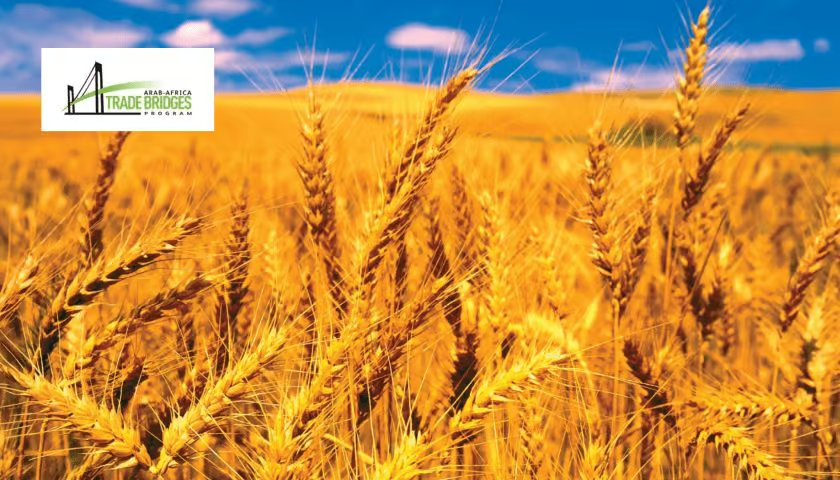
MAURITANIA – Mauritania has embarked on a major agricultural transformation with the launch of a national wheat seed multiplication programme under the Arab Africa Trade Bridges (AATB) initiative.
This strategic project, executed in collaboration with the Arab Center for the Studies of Arid Zones and Dry Lands (ACSAD) and the International Islamic Trade Finance Corporation (ITFC) aims to boost local production, reduce dependency on imports, and strengthen the country’s wheat value chain.
The AATB Program is a multi-donor, multi-country, and multi-organization program supported by the African Export-Import Bank (Afreximbank), Arab Bank for Economic Development in Africa (BADEA), Islamic Development Bank, the International Islamic Trade Finance Corporation (ITFC), the Islamic Corporation for the Insurance of Investment and Export Credit (ICIEC), and the Islamic Corporation for the Development of the Private Sector (ICD).
The Program aims to promote and increase trade and investment flows between African and Arab OIC Member Countries; provide and support trade finance and export credit insurance, and enhance existing capacity-building tools relating to trade.
The Mauritania initiative was formalized via a Memorandum of Understanding signed in November 2023, with implementation coordinated closely with Mauritania’s Ministry of Agriculture and Food Sovereignty.
Drawing on ACSAD’s technical expertise and financial backing from the AATB Program, the project focuses on reducing Mauritania’s heavy reliance on wheat imports through the local multiplication of high-yield wheat seeds.
By establishing a comprehensive national program, it promotes the adoption of certified ACSAD varieties of hard and soft wheat, while minimizing risks such as disease and genetic contamination in cultivation.
Key objectives include the development of climate-resilient wheat strains adapted to local conditions, particularly in response to challenges like drought and high temperatures exacerbated by climate change. A national wheat breeding program is set to commence this season, emphasizing high-efficiency, disease-free seeds.
During the 2023–2024 agricultural season, ACSAD supplied improved wheat varieties for cultivation on a 20-hectare site in the Arkez region.
The first harvest produced over 16 tonnes of soft and hard wheat, which were then used for seed multiplication during the 2024–2025 season. To oversee and guide the project, a steering committee comprising representatives from ACSAD, ITFC, and the Ministry met for the first time in September 2024 and again in May 2025.
These meetings reviewed achievements and approved the next phase, which includes expanding wheat cultivation to additional provinces and launching a national breeding program. This program will focus on developing new high-yield varieties adapted to local conditions and tolerant to challenges such as drought and high temperatures, which are increasingly pressing under climate change.
Beyond seed production, the project addresses broader aspects of the wheat value chain. It promotes improved agricultural practices, better harvest and post-harvest management, and the modernization of institutional frameworks governing wheat production and marketing.
These efforts are intended to reduce crop losses, minimize genetic contamination in cultivation, and create a more efficient and resilient system for wheat production in the country.
Sign up to HERE receive our email newsletters with the latest news and insights from Africa and around the world, and follow us on our WhatsApp channel for updates.