

Maize farmers in Uganda count heavy losses as prices plunge
Producers who had invested heavily in pesticides, fertilizers, labour, and rented land said they expected better returns, only to be disappointed by low market prices.
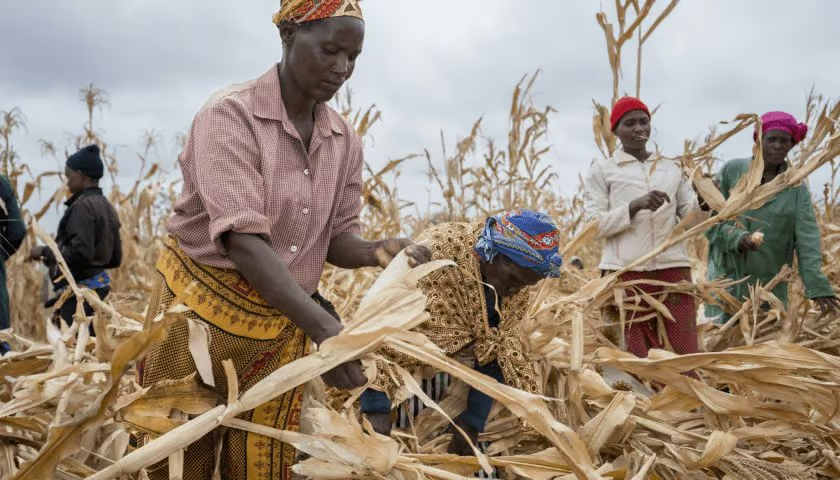
UGANDA – Farmers in the greater Kibaale region of Uganda, covering Kagadi, Kakumiro, and Kibaale districts, are facing steep financial losses after maize prices dropped sharply during the peak harvest season.
The plummeting prices, attributed to an oversupply of maize, have dashed hopes of profitable returns for farmers who invested heavily in their crops, leaving many struggling to cover debts and basic expenses.
Last season, maize fetched between Shs900 and Shs1,000 per kilogram (US$0.24–US$0.27), encouraging many farmers to plant extensively after reaping good profits.
However, this season, prices have plummeted to between Shs500 and Shs700 per kilogram (US$0.13–US$0.19), driven by a surge in supply as more farmers entered the market. The result has been devastating for farmers, with only middlemen and casual workers reportedly benefiting from the situation.
Farmers across the region expressed frustration over their reliance on middlemen and the lack of storage facilities, which forces them to sell at low prices to avoid spoilage. Many, burdened by loans from banks and savings cooperatives, are now struggling to repay debts. As a result, several farmers are considering diversifying their crops, with beans emerging as a popular alternative due to their more stable market prices.
Mr. Dezii Katongore, a large-scale farmer from Kitonya Village in Bubango Sub-County, Kibaale District, shared his frustration. He invested over Shs2 million (US$540) in pesticides, labor, and land rental, expecting to harvest 90 sacks and earn more than Shs4 million (US$1,080).
However, a prolonged dry spell reduced his yield to just 52 sacks, and he was forced to sell at Shs750 per kilogram (US$0.20) instead of the anticipated Shs1,000 (US$0.27).
“I had nowhere to store the maize. If I had kept it, it would have spoiled. I don’t know if I will farm maize again next season,” Katongore said in an interview on September 8.
Similarly, Mr. Katangwe Birungi, a small-scale farmer from Kataara Village in Kibaale District, invested over Shs1 million (US$270) in his four-acre maize farm. He harvested 28 sacks, earning just Shs1.26 million (US$340) instead of the expected Shs3 million (US$810). The shortfall left him unable to pay school fees for his children, prompting him to consider switching to beans, which he believes offer more stable prices.
Mr. Businge Byamukama from Kijungu Village in Kagadi District faced similar challenges. After spending nearly Shs900,000 (US$243) on his two-acre maize farm, he harvested only 27 sacks and sold them at a meager Shs250 per kilogram (US$0.07), earning just Shs1 million (US$270). From this, he had to repay a Shs300,000 (US$81) loan, cover Shs200,000 (US$54) in school fees, and settle Shs100,000 (US$27) in hospital bills, leaving little for his family’s needs.
“I was forced to sell because I couldn’t afford storage. I’m planning to intercrop next season because relying on one crop isn’t sustainable,” he said.
Mr. Zimwanguhiiza Byaruhanga, another farmer from Kibaale District, invested about Shs800,000 (US$216) in his two-acre farm, expecting 20 sacks but harvesting only 16. He had hoped to sell at Shs1,000 per kilogram (US$0.27) but was forced to accept Shs500 (US$0.13).
He accused middlemen of exploiting farmers by offering unfair prices and manipulating measurements, urging the government to regulate the market to protect farmers.
Sign up to HERE receive our email newsletters with the latest news and insights from Africa and around the world, and follow us on our WhatsApp channel for updates.