

Kenya sets new wheat prices, import quotas for 2025/26 to encourage local production
The prices and import quotas were agreed upon during the stakeholder workshop held from June 24–27, 2025
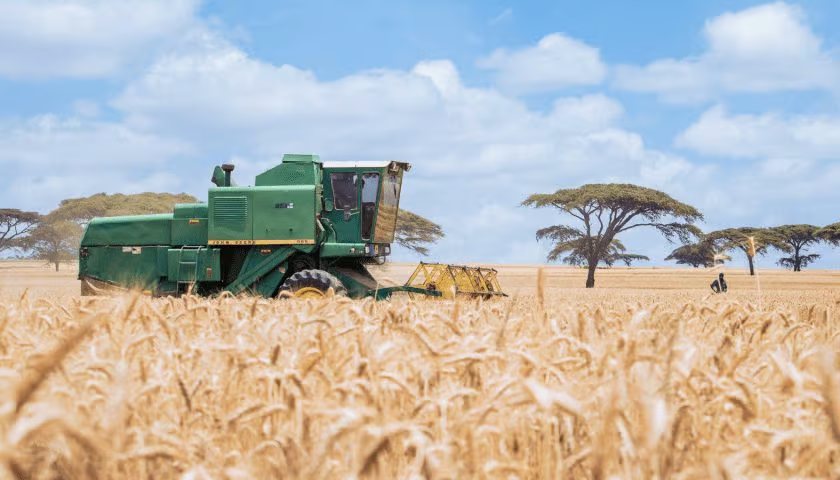
KENYA – Kenya has announced new wheat prices and import quota rules for the 2025/26 season, aiming to boost local production while ensuring fair compensation to farmers.
Under the revised structure, the Agriculture and Food Authority (AFA) has set the minimum price for Grade 1 wheat (78 lbs and above) at approximately KES 4,750 (US$37) per 90 kg bag, while Grade 2 (75–77.9 lbs) will trade at around KES 4,650 (US$36) per bag.
Wheat classified under Grade 3 (below 75 lbs) will continue to be traded under a willing buyer, willing seller arrangement.
Additionally, a handling fee of KES220 (US$1.70) per 90 kg bag will be paid to registered aggregators for weighing, offloading, and testing services, shared equally between millers and farmers to ensure quality and fair process management across the value chain.
These decisions were reached following a stakeholder workshop held in late June 2025, with a follow-up meeting in early July to finalise the 2024/25 season and align policies for the new cycle. The aim is to stabilise the local wheat industry, improve farmer margins, and reduce the country’s dependency on imports while maintaining affordability for millers and consumers.
The AFA, working with the National Treasury, evaluated millers applying to import wheat under the Duty Remission Scheme (DRS), with approvals based on millers’ previous quota utilization, local purchase performance, and milling capacity.
All approved millers will be required to purchase locally grown wheat proportional to their allocated import quotas, reinforcing Kenya’s policy to reduce overreliance on imports while safeguarding farmer incomes.
Under the WPP, millers gazetted by the East African Community (EAC) Customs Union will continue benefiting from a reduced import duty rate of 10% (down from the standard 35% under the EAC Common External Tariff) provided they buy locally produced wheat at the negotiated prices.
Dr. Bruno Linyiru, AFA Director General, affirmed that all commitments agreed upon during the stakeholder negotiations are binding, with any future amendments to the WPP to be communicated following further consultations.
The structured pricing and quota allocation come as Kenya’s wheat sector faces high production costs, climate variability, and import dependence pressures. By linking quota allocations with mandatory local purchases, Kenya aims to protect farmer margins while ensuring millers have access to competitively priced grain under the duty remission structure.
Stakeholders, including the Cereal Millers Association (CMA) and the Cereal Growers Association (CGA), will continue collaborating with the AFA to monitor the implementation of these new measures throughout the 2025/26 season to enhance productivity and sector stability.
Sign up to HERE receive our email newsletters with the latest news and insights from Africa and around the world, and follow us on our WhatsApp channel for updates.