
Kenya harvests first maize crop at Galana Kulalu Scheme
The successful harvest marks a critical milestone in the government’s renewed efforts to reposition the scheme as a cornerstone of Kenya’s food security

KENYA – Kenya has announced that harvesting of the first maize crop at the Galana Kulalu Irrigation Scheme, a national food security project, has begun, marking a remarkable turnaround for an initiative that was widely dismissed as a failure.
The Galana Kulalu Food Security Project, situated on vast government land in Kilifi and Tana River counties, is being implemented under a public-private partnership (PPP) between the Government of Kenya and Selu Limited.
The project aims to harness irrigation to ensure year-round food production, particularly in arid and semi-arid regions, and reduce the country’s dependence on rain-fed agriculture.
Initially launched nearly a decade ago, the Galana Kulalu project was envisioned to irrigate one million acres and enhance Kenya’s maize self-sufficiency. However, implementation challenges, ranging from infrastructure delays to project mismanagement, slowed its progress, drawing public criticism.
Speaking during the launch of the harvest, Water, Sanitation and Irrigation Cabinet Secretary Eric Mugaa said the scheme is on course to become a major food production hub and a key pillar of Kenya’s food security agenda.
“The Galana Kulalu project is on track to become a food hub for Kenya, supporting the government’s Bottom-Up Economic Transformation Agenda to make the country food secure and reduce the KES500 billion (US$ 3.8 billion) annual food import bill,” said Mugaa.
He said that the first crop being harvested is evidence of that commitment.
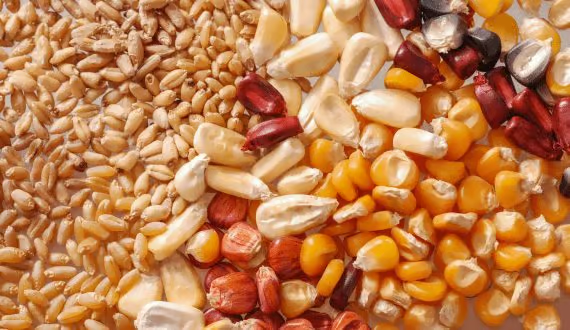
From the first 1,500 acres of seed maize planted, yields have averaged between 28 and 30 bags per acre, an outcome that government officials say demonstrates the strong potential of irrigation-based food production.
The successful harvest marks a critical milestone in the government’s renewed efforts to reposition the scheme as a cornerstone of Kenya’s food security and economic transformation agenda.
The revival follows extensive government investment in irrigation infrastructure, including a 20,000-cubic-metre intake well, a two-kilometre water canal, a 550,000-cubic-metre reservoir, and a 20,000-cubic-metre offtake pump that now supplies water to the initial farms.
Officials say these developments have resolved long-standing water supply challenges that previously hampered the project’s productivity.
The Cabinet Secretary added that about 330 acres of the current crop will be harvested over five days.
According to Mugaa, with the availability of irrigation water from two small dams, Selu Limited will soon expand the irrigated area to 6,300 acres.
“However, the long-term plan is to build a large dam in Galana capable of irrigating 200,000 acres, ensuring sustainable national food production,” he added.
Expansion and Job Creation
Selu Limited Chief Executive Officer Nicholas Ambanya said the company plans to progressively expand maize cultivation to 3,200 acres by the end of 2025 and 5,400 acres by June 2026, eventually reaching 20,000 acres as more irrigation water becomes available.
“The project has already created about 200 jobs, and more Kenyans will be employed as we expand production,” Ambanya said.
Sign up to HERE receive our email newsletters with the latest news and insights from Africa and around the world, and follow us on our WhatsApp channel for updates.