
Grains, oilseed prices slide further in 2025 as supply outpaces demand: World Bank
Prices are expected to edge down further into 2026, constrained by trade uncertainty and modest global consumption growth.
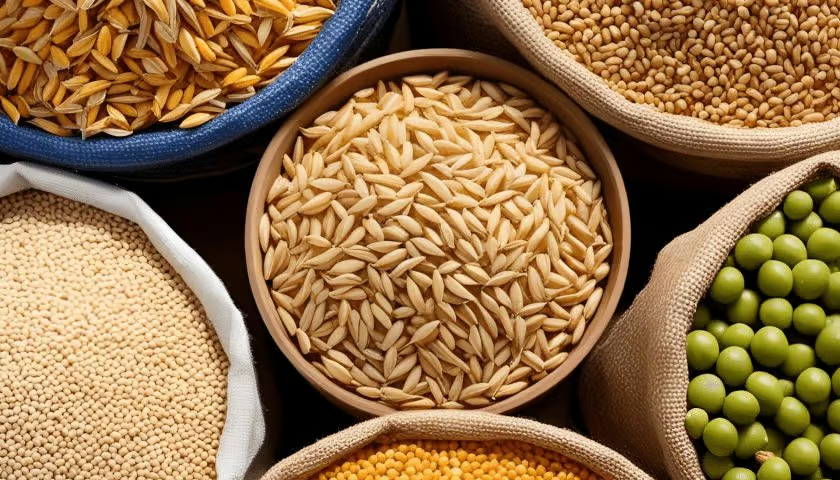
GLOBAL – According to the World Bank’s latest Commodity Markets Outlook, the prices of key grains and oilseeds, including wheat, maize, soybeans, and their processed products, are forecast to decline throughout 2025 as global supplies improve and demand remains subdued due to trade tensions and lower energy prices.
Wheat prices, after fluctuating in early 2025, have declined amid better weather conditions and healthy harvest projections in key exporting countries.
Prices are expected to edge down further into 2026, constrained by trade uncertainty and modest global consumption growth.
Maize prices, which spiked earlier due to drought conditions in South America, are now easing. Improved weather in Argentina and Brazil has strengthened the global supply outlook.
Moreover, weaker oil prices have reduced the demand for maize-based ethanol, especially in the United States, putting further downward pressure on maize prices. The World Bank projects a 2% drop in maize prices in both 2025 and 2026.
Oilseed prices continue to ease in 2025
In the oilseeds segment, soybean markets are softening considerably. Soybean prices fell by 5% in the first quarter of 2025 and are expected to decline by 17% over the year.
A projected 6% increase in global production, driven by acreage expansion and favourable yields, is contributing to a supply surplus.
Additionally, China’s tariffs on U.S. soybeans, amid worsening trade relations, have depressed U.S. benchmark prices.
China typically imports 60% of global soybeans, making its purchasing patterns highly influential.
Soybean oil prices, a key input for food processors and biofuel producers, have remained somewhat resilient, still 10% higher year-on-year due to tight supplies of competing oils like palm and sunflower oil.
However, they too are forecast to soften slightly, by 3% in 2025, as production rebounds and crude oil prices continue to decline, limiting demand for biofuel feedstocks.
Soybean meal, an essential ingredient in livestock and aquafeed, saw a 7% price decline in Q1 and is projected to drop by 16% this year. The decline reflects increased soybean crushing and weaker feed demand in major consuming markets.
For millers and processors, these developments signal both opportunities and risks. On one hand, lower input costs could ease pressure on operating margins, especially for small and medium-sized operations.
On the other, the volatility and trade-related distortions in global commodity markets may disrupt sourcing strategies and pricing models.
“Higher commodity prices have been a boon for many developing economies, two-thirds of which are commodity exporters. But we’re now seeing the highest price volatility in more than 50 years. The combination of high price volatility and low prices spells trouble,” said Indermit Gill, the World Bank Group’s Chief Economist and Senior Vice President for Development Economics.
Long-term, the price outlook for both grains and oilseeds is expected to stabilise in 2026. However, ongoing geopolitical tensions, climate variability, and shifting biofuel policies remain key wildcards that could reverse current trends.
“Developing economies will need to take three steps to protect themselves: first, restore fiscal discipline; second, create a more business-friendly environment to attract private capital; third, liberalise trade wherever the opportunity exists,” Indermit Gill added.
Sign up to HERE receive our email newsletters with the latest news and insights from Africa and around the world, and follow us on our WhatsApp channel for updates.