

Burkina Faso commissions 100-tpd rice milling facility
It covers paddy cleaning, husking, whitening, polishing, optical sorting, grain calibration and packaging of white rice.
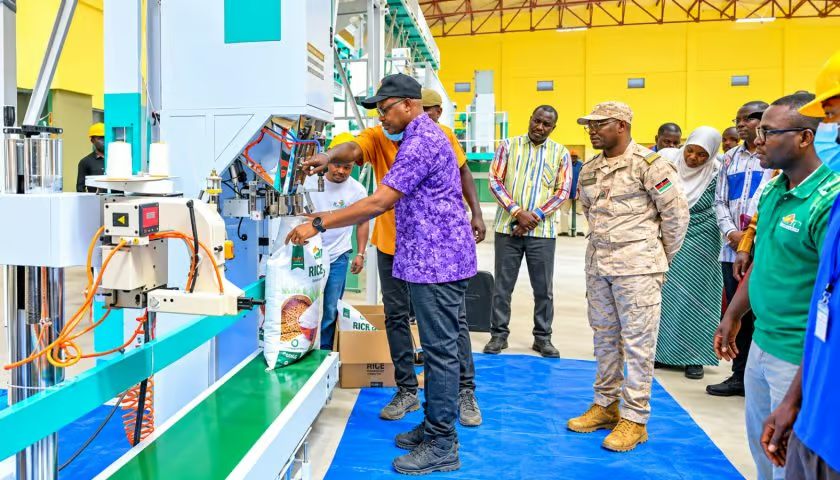
BURKINA FASO – The government has inaugurated a new public rice-milling facility in Bagré, in the east-central Nakambé region, with a capacity of 100 tonnes of paddy rice per day.
The plant, commissioned on 20 October 2026, is intended to strengthen domestic rice processing, improve market opportunities for local farmers and advance the country’s drive towards food sovereignty.
Prime Minister Rimtalba Jean Emmanuel Ouédraogo inaugurated the facility, which the state-owned company Faso Agropôles (SOFA) operates and which the government financed entirely with its own resources.
According to the Prime Minister’s Office, the investment forms part of the 2026-2028 Agro-Pastoral, Hydraulic and Fisheries Offensive, a national programme designed to increase agricultural production, expand processing infrastructure and improve food security.
The new mill features an integrated processing line covering the main stages of rice production, from cleaning paddy rice to packaging finished white rice.
Its equipment includes husking, whitening, polishing, optical sorting and grain-calibration machinery, enabling the facility to improve product quality and prepare locally harvested rice for commercial markets.
A key objective is to process paddy stocks the government has accumulated through its farm-gate procurement programme.
By purchasing rice directly from producers and processing it locally, authorities aim to create more reliable outlets for farmers, add value to domestic harvests and improve the availability of locally processed rice.
The inauguration comes amid a significant expansion in Burkina Faso’s agricultural output.
According to the African Press Agency (APA), national paddy rice production reached a record 1,008,737 tonnes in 2025, surpassing one million tonnes for the first time.
Total cereal production rose to 7.14 million tonnes that year, strengthening domestic food availability and increasing demand for storage, milling, and distribution infrastructure.
The government’s broader strategy is to ensure that rising agricultural production is matched by sufficient industrial capacity to process and market crops.
Without adequate milling infrastructure, farmers may struggle to sell their harvests, while the country may continue to rely on imported processed food products despite rising domestic production.
Speaking at the inauguration, Ouédraogo emphasized the importance of linking agricultural production with industrial processing to generate greater economic value within Burkina Faso.
He also called for the facility’s protection and sustainable management, tasking SOFA with ensuring efficient operations and stronger cooperation with producers.
The government has indicated it will establish additional processing facilities in other regions as part of its agropoles development policy.
The success of the Bagré mill will depend on consistent paddy supplies, efficient operations, and the ability to distribute competitively priced rice to consumers.
Sign up to HERE receive our email newsletters with the latest news and insights from Africa and around the world, and follow us on our WhatsApp channel for updates.
