
Kenya seeks Indian investors to expand rice production
Kenya is exploring an Indian agricultural investment model to turn the Bura Irrigation Scheme in Tana River County into a major rice production hub, with a proposed 35,000-acre development projected to produce 78,750 metric tonnes of rice per production cycle.
KENYA – Kenya seeks to attract Indian investors and adopt advanced agricultural technologies to expand its rice industry, strengthen food security, and reduce dependence on imported rice.
The initiative follows renewed engagement between the two countries on irrigation development, rice cultivation and agro-processing, as the government explores opportunities to increase domestic production and improve the efficiency of the rice value chain.
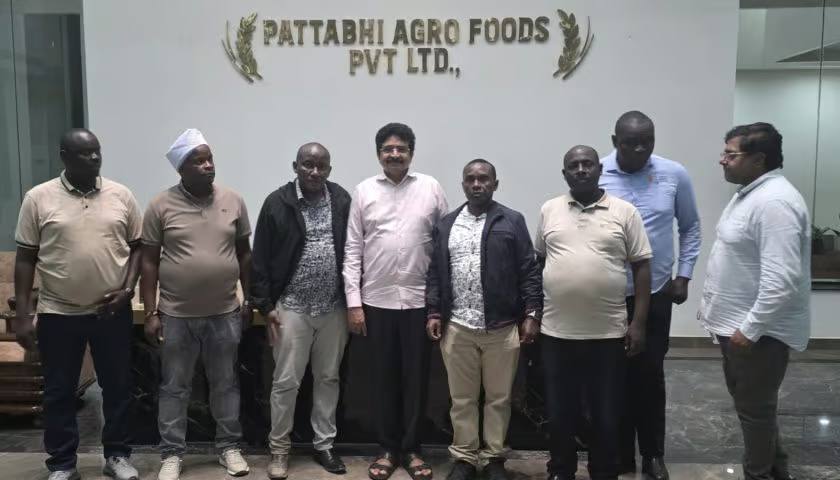
On Wednesday, October 21, 2026, a Kenyan delegation led by Principal Secretary for Irrigation Ephantus Kimotho visited India to explore opportunities for collaboration with Pattabhi Agro Foods Private Limited and United Port Services Private Limited.
The delegation was also to examine agricultural investment models that combine private-sector capital, modern irrigation infrastructure and large-scale farming.
The delegation toured Hyderabad, Telangana, and Kakinada, Andhra Pradesh, following an invitation from United Port Services Private Limited.
The visit also included an inspection of the Polavaram Irrigation Project, which offers lessons in integrated water management and irrigation development.
The government is assessing how elements of India’s agricultural investment model could be applied to Kenya, particularly through the proposed transformation of the Bura Irrigation Scheme in Tana River County.
The proposed development envisages bringing 35,000 acres under rice cultivation, with an estimated production potential of 78,750 metric tonnes per production cycle, according to Rice News Today.
Kenya’s rice sector faces a substantial supply gap as domestic production remains below national consumption.
At the Bharat International Rice Conference 2026, Kenyan government economist Stephen Nyaga said the country consumes approximately 1.1 million metric tonnes of rice annually, while domestic production stands at about 300,000 tonnes.
Imports therefore remain essential to meet demand, creating opportunities to invest in farming, irrigation, storage, milling, and distribution.
India’s experience in irrigation, high-yielding rice varieties and processing technology could help Kenya address some of these challenges.
The government is also interested in improving water harvesting and storage, mechanizing agricultural operations and making better use of rice-processing by-products, including broken rice for animal feed.
The proposed investment drive aligns with Kenya’s broader irrigation expansion agenda under the National Irrigation Sector Investment Plan 2025-2035.
The government aims to increase irrigated agricultural land and improve productivity through infrastructure development, rehabilitation of existing schemes and private-sector participation.
If implemented successfully, the initiative could create employment, improve market access for farmers, expand local processing capacity, and reduce foreign-exchange expenditure on rice imports.
However, its success will depend on financing commitments, reliable water supplies, suitable production technologies, transparent land arrangements and commercially viable markets.
The discussions represent an opportunity to strengthen Kenya–India agricultural cooperation, although the proposed Bura development’s projected output and investment arrangements remain subject to implementation.
This search for partners comes at a time when Kenya remains heavily reliant on imports to meet its demand for the grain.
In East Africa’s largest economy, annual milled rice production ranges from 160,000 to 180,000 tons, primarily sourced from the Mwea irrigation scheme, the country’s main production area.
Sign up to HERE receive our email newsletters with the latest news and insights from Africa and around the world, and follow us on our WhatsApp channel for updates.